Why Your Skincare Stopped Working the Moment the Weather Changed
Quick Answer: Ambient humidity determines how much water your skin loses to the air and how humectant ingredients behave. As outdoor humidity drops and indoor heating starts, a lightweight summer routine stops holding moisture - and humectants like glycerin and hyaluronic acid can pull water out of the skin rather than into it if there is nothing sealing them in. The fix is usually one occlusive step, not a whole new routine.
Most autumn skincare problems are solved by adding one product on top of what you already own, and the product is cheaper than the one people usually buy instead.

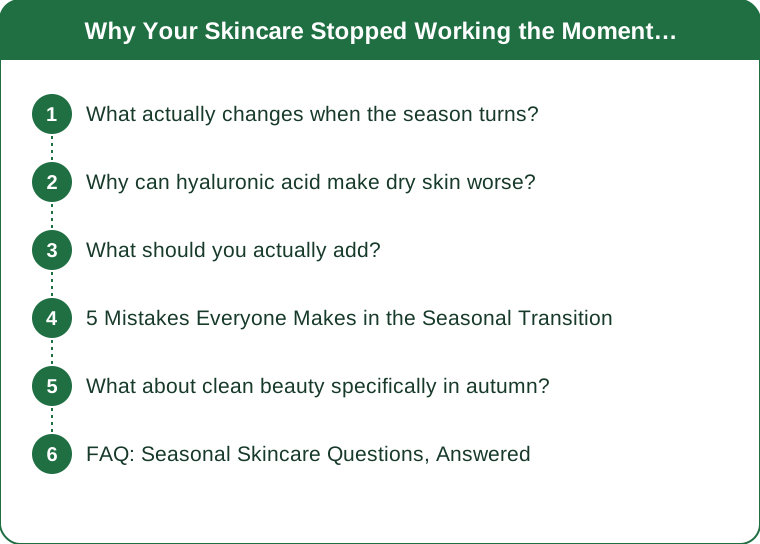
What actually changes when the season turns?
Three things, and they compound.
Outdoor humidity falls. Skin loses water to the surrounding air continuously - transepidermal water loss - and the drier the air, the faster it happens. The same skin, with the same barrier, loses more water in September than in July with no change in behaviour.
Indoor heating starts. This is the larger factor and it arrives suddenly. Heated indoor air can be very dry, and you spend most of your day in it. The transition from an unheated house to a heated one often produces a visible change in skin within about a week.
Temperature swings increase. Moving between cold outdoor air and warm indoor air repeatedly affects the skin barrier and vascular response, which is why redness and sensitivity tend to increase in the transitional weeks.
What that produces, in the order people notice it:
- Tightness after cleansing that did not used to happen
- Foundation catching and looking patchy, which is usually the first sign for people who wear makeup
- Flaking around the nose and eyebrows
- Increased sensitivity - products that were fine now sting slightly
- More oil in some cases, not less, because a dehydrated barrier can trigger increased oil production
The last point causes the most confusion. Oily skin that suddenly gets oilier in autumn is frequently dehydrated rather than oily, and treating it with more astringent products makes it worse.
Why can hyaluronic acid make dry skin worse?
Because humectants move water toward wherever there is more of it, and in dry air that direction can reverse.
How humectants work. Glycerin, hyaluronic acid, and similar ingredients bind water and hold it. In humid conditions, they draw moisture from the air and from the deeper layers of skin toward the surface, which is why they feel excellent in summer.
In dry air, the gradient changes. With very little moisture available in the environment, a humectant applied to the skin surface can draw water from the deeper layers and that water then evaporates. The result is a product that feels hydrating on application and leaves skin tighter than before - which is exactly the complaint people report about hyaluronic acid in winter.
The fix is not to stop using it. It is to seal it.
- Apply humectants to damp skin, not dry. This gives them water to work with immediately
- Follow with an occlusive or emollient layer within a minute or so, before the water evaporates. This is the step most people skip
- Do not layer three humectant serums and stop there, which is a common routine and the most likely one to produce tightness in dry air
What an occlusive actually does: it forms a physical barrier that slows evaporation. Common ones include petrolatum, shea butter, squalane, jojoba, and various plant butters and waxes. Petrolatum is among the most effective occlusives available and is one of the least expensive products in any pharmacy - a fact that sits awkwardly with clean beauty marketing, though it is well-established and well-tolerated for most people.
Emollients versus occlusives, briefly: emollients like squalane and plant oils soften and smooth by filling gaps between skin cells. Occlusives seal. Many products do both. If your skin feels tight despite using oils, an occlusive step rather than more oil is usually the answer.
What should you actually add?
One step, in the right place, before restructuring anything.
The order that works for autumn:
- Cleanser - switch to a gentler, less stripping one if you are using a foaming gel. This is the second most impactful change after the occlusive
- Humectant serum on damp skin - the same one you were using is fine
- Moisturiser - a richer texture than your summer one
- Occlusive, at night, on top of everything. This is the addition
- Sunscreen in the morning, which does not become optional in autumn
Products that work as the occlusive step:
- A balm or ointment applied thinly at night. Sometimes described as slugging, and it is simply an occlusive final layer
- A facial oil with a higher occlusive fraction, though most plant oils are more emollient than occlusive
- A richer night cream, which builds the occlusive into the moisturiser
Where people go wrong: buying an entirely new routine in September. The routine was not wrong - the environment changed. Adding one sealing step at night, and gentling the cleanser, resolves the majority of transitional-season complaints for a fraction of the cost.
On actives during the transition. Retinoids, exfoliating acids, and vitamin C all become more irritating when the barrier is compromised, and the barrier is under more strain in autumn. Reduce frequency before reducing strength - moving a nightly retinoid to every other night through the transition is usually enough. Adding a new active during a season change is poor timing.
A humidifier is the underrated option. It addresses the cause rather than the symptom, particularly in a bedroom with heating on overnight. For anyone with persistently dry or eczema-prone skin, it does more than any product.
5 Mistakes Everyone Makes in the Seasonal Transition
1. Layering humectants with nothing on top. Three hydrating serums in dry air can leave skin tighter than one serum plus a cream. The sealing step is what makes humectants work.
2. Keeping the summer cleanser. A foaming gel cleanser that felt perfect in humid heat is usually too stripping once humidity drops. A cream or oil cleanser is a bigger upgrade than most people expect.
3. Treating dehydration as oiliness. Skin that gets oilier in autumn is often dehydrated and overproducing. Adding more astringent products deepens the cycle. This is the single most common misdiagnosis in seasonal skincare.
4. Starting a new active at the same time. Season change plus a new retinoid is two variables at once, and when the irritation arrives you cannot tell which caused it. Change one thing at a time, two weeks apart.
5. Dropping sunscreen. UVA levels remain meaningful outside summer and penetrate cloud and glass. Autumn sunscreen use falls off sharply and the exposure does not fall off proportionally.
What about clean beauty specifically in autumn?
The seasonal transition exposes a few real tensions in clean formulations that are worth knowing about.
Preservation and richer textures. Heavier autumn creams contain more oils and, often, more water - which is precisely the environment that requires robust preservation. A preservative-light formulation in a rich cream jar is more vulnerable than a lightweight serum in a pump. Choosing airless packaging or tubes over open jars matters more for these products than for summer ones.
Fragrance and a compromised barrier. Essential oils and natural fragrance components are among the more common sources of contact irritation, and a barrier under seasonal strain is more reactive. Autumn is the season where fragrance-free versions genuinely earn their place, natural or otherwise.
Occlusives and the natural preference. The most effective occlusives are petrolatum and mineral-derived ingredients, which many clean beauty ranges exclude. The plant-based alternatives - shea, cocoa butter, beeswax, squalane - are effective emollients and generally less occlusive. If a plant-based routine is not holding moisture, that is a formulation gap rather than a failure on your part, and it can be addressed with a heavier butter-based balm or by accepting a mineral occlusive for the season.
Shelf life in a heated house. Products stored in a bathroom with heating running go through more temperature cycling than in summer, and unstable ingredients - vitamin C in particular, plus cold-pressed oils - degrade faster. Store actives somewhere cool and dark, and check whether oils smell rancid rather than assuming they last indefinitely.
What to actually buy, if anything: a gentler cleanser, one richer night product with a sealing function, and a fragrance-free option if your skin is reactive. That is a smaller and cheaper list than the seasonal marketing suggests, and it covers most of the problem.
If you have persistent flaking, redness, or itching that does not respond to a richer routine, that is worth showing to a doctor or dermatologist - eczema, seborrhoeic dermatitis, and rosacea all commonly flare in autumn and are treated differently from simple dryness. This is general information rather than medical advice.

FAQ: Seasonal Skincare Questions, Answered
Why does my skin feel tight even though I use hyaluronic acid?
In dry air, humectants can draw water from deeper skin layers and lose it to evaporation. Apply to damp skin and seal with a moisturiser or occlusive within a minute.
Should I change my whole routine for autumn?
Usually not. A gentler cleanser and one sealing step at night resolves most transitional complaints without replacing anything else.
Why is my skin oilier in autumn, not drier?
Dehydration can trigger increased oil production. Treating it with astringent products deepens the cycle - a hydrating routine with a proper seal usually settles it.
Do I still need sunscreen?
Yes. UVA levels remain meaningful year-round and penetrate cloud and window glass. Autumn use drops off far more than the exposure does.
Is a humidifier worth it?
For a heated bedroom in autumn and winter, genuinely yes - it addresses the cause rather than the symptom and often does more than any single product.
TL;DR:
- Falling humidity plus indoor heating increases water loss from skin without anything about you changing
- Humectants need something on top of them in dry air, or they can leave skin tighter than before
- Add one occlusive step at night and gentle the cleanser before buying anything else
- Oily-in-autumn is often dehydration, and astringent products make it worse
- Reduce active frequency through the transition and do not start a new one at the same time
The routine did not stop working. The air changed, and one sealing step usually puts it right.
Keep Reading
This article is for general informational and styling purposes only. Fit, sizing, and product availability may vary.