The End-of-Summer Skincare Audit: What to Bin, Keep, and Move
Quick Answer: Work through the shelf in one pass and sort into three piles. Bin anything with a changed colour, smell, or texture, anything past its period-after-opening symbol, and any sunscreen or active that’s spent the summer in a hot car or a sunny window. Keep and move anything heat-sensitive - vitamin C, retinoids, preservative-light natural formulas - to a cool dark cupboard. And downgrade rather than bin lightweight summer formulas: they still work, they just belong under a richer layer now that humidity is dropping.
The jar looks fine. Products rarely announce that they’ve degraded - the ones that have changed colour are the honest ones.

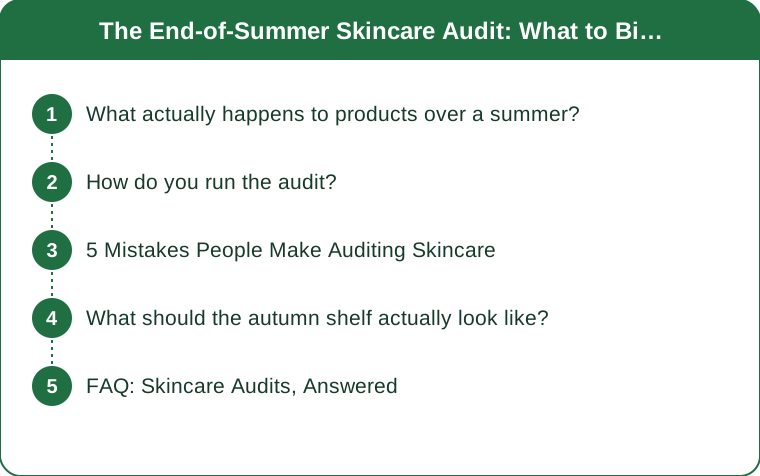
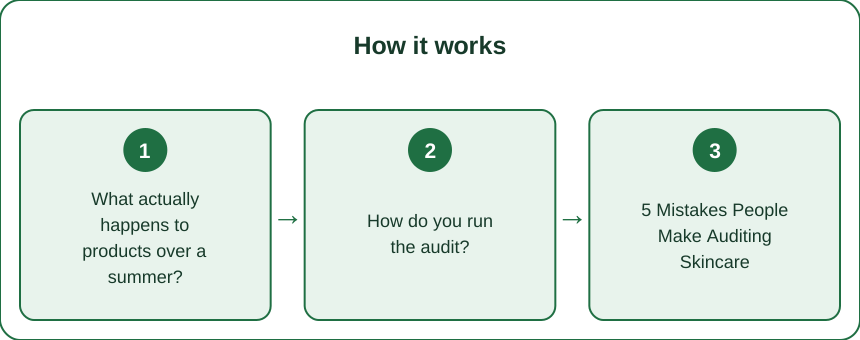
What actually happens to products over a summer?
Heat accelerates chemical degradation. Storage temperature is one of the main variables in how quickly an active ingredient breaks down, which is why a bathroom windowsill and a car glovebox are the two worst places in most people’s homes.
Light degrades specific actives. Vitamin C, retinoids, and some plant extracts are light-sensitive, which is precisely why they’re sold in opaque or amber packaging - packaging that stops helping the moment the bottle sits in a sunny spot.
Air exposure matters as much as time. Every opening introduces oxygen, and oxidation is what turns a vitamin C serum from clear to orange or brown. Jars are worse than pumps for exactly this reason.
Preservative systems have limits. Formulas with lighter preservative systems - common in natural and clean-positioned products - typically have shorter shelf lives once opened, and warmth and finger-dipping both shorten them further.
Water plus warmth plus fingers is how contamination starts. Any product containing water can support microbial growth, and a gym bag is a warm, damp environment that accelerates it.
And the period-after-opening symbol is the number that matters. The small open-jar icon with 6M or 12M refers to time after opening, not the unopened shelf life - and almost nobody writes the opening date on the packaging, which is why the symbol goes unused.
How do you run the audit?
Take everything off the shelf first. Auditing in place means you skip the things at the back, which are exactly the ones most likely to be past it.
Check three senses on each product: colour, smell, texture. A serum that’s turned orange or brown, a cream that’s separated and won’t remix, an oil that smells sharp or crayon-like. Any one of these is a bin decision, regardless of date.
Look for the open-jar symbol and estimate honestly. If you can’t remember when you opened it and it’s a 6M product you bought in spring, it’s done. Guessing generously is how people keep using degraded actives.
Sort sunscreen strictly. Sunscreen that’s been in a hot car, a beach bag, or direct sun for a summer should go. It’s the one category where degradation carries a real consequence, and it’s the category most likely to have been stored badly.
Move the survivors to a cool, dark, dry place. Not the bathroom windowsill, not the shelf above a radiator. A bedroom drawer or a hallway cupboard beats most bathrooms.
And write the opening date on the new ones as you open them. A marker pen on the base of the bottle. It takes two seconds and it makes every future audit take a fraction of the time.

5 Mistakes People Make Auditing Skincare
Mistake 1: binning things that are simply too light for the season. A gel moisturiser that felt perfect in August isn’t expired - it’s under-specified for lower humidity. Keep it and layer something richer over it.
Mistake 2: trusting an unopened-looking product. Once opened, the clock is the period-after-opening symbol, not the expiry date. A barely-used jar from last summer is still a jar that’s been open for a year.
Mistake 3: keeping vitamin C that’s changed colour. A serum that’s gone yellow-orange or brown has oxidised. It’s not dangerous, but it’s not doing what you bought it for.
Mistake 4: storing everything in the bathroom. Heat and humidity from showers make bathrooms one of the worse storage locations, particularly for actives and for products with lighter preservative systems.
Mistake 5: replacing everything at once. A full shelf replacement means five new products introduced simultaneously, and if your skin reacts you’ll have no idea which one. Introduce new products one at a time, several days apart, and patch test.
What should the autumn shelf actually look like?
A richer moisturiser, or a layer over the summer one. As humidity drops, the same routine that felt balanced in August starts to feel tight. Adding an occlusive layer at night is usually enough without replacing anything.
Sunscreen stays, unchanged. UV exposure continues in autumn, and this is the single most commonly abandoned autumn step. A fresh bottle after a summer of heat storage is the sensible move.
Actives can often be reintroduced or increased. Lower UV and less sweat make autumn a common time for people to start or step up retinoid use. Go slowly, introduce one thing at a time, and expect an adjustment period.
Fewer products, used consistently, beats more products. An audit is a good moment to notice that you own four serums and use one. Consistency drives results far more than variety does.
Keep the gym bag separate and small. Whatever lives in a bag should be a small, replaceable, preferably anhydrous or well-preserved product - not your expensive serum.
And patch test anything new. This is general information, not medical advice. Persistent irritation, a reaction that spreads, or any skin change you’re unsure about is worth taking to a pharmacist, GP, or dermatologist rather than troubleshooting with more products.
FAQ: Skincare Audits, Answered
How do I know if my skincare has expired?
Check colour, smell, and texture first - a changed colour, an off or sharp smell, or separation that won’t remix are all reliable signs. Then check the period-after-opening symbol, the small open-jar icon showing 6M, 12M, and so on.
Does heat ruin skincare?
It accelerates degradation, particularly for actives like vitamin C and retinoids and for formulas with lighter preservative systems. A hot car, a sunny windowsill, and a steamy bathroom are the three worst common storage spots.
Should I throw away last summer’s sunscreen?
If it’s spent a summer in a hot car or a beach bag, replacing it is the sensible call - it’s the one product where degradation has a direct consequence. Check the expiry date and the storage history rather than just the fill level.
Where should I store skincare?
Somewhere cool, dark, and dry - a bedroom drawer or hallway cupboard is usually better than a bathroom, which combines heat and humidity in exactly the way that shortens shelf life.
TL;DR:
- Take everything off the shelf and check colour, smell, and texture before checking dates.
- The period-after-opening symbol is the number that matters - write the opening date on new products as you open them.
- Replace sunscreen that’s spent the summer in a hot car or beach bag; it’s the one category where degradation has a real cost.
- Move heat- and light-sensitive actives out of the bathroom to a cool dark cupboard.
- Don’t bin light summer formulas - layer something richer over them as humidity drops.
Products don’t tell you they’ve stopped working. The ones that changed colour were being generous.
Keep Reading
This article is for general informational and styling purposes only. Fit, sizing, and product availability may vary.