Why Your Clean Beauty Routine Needs Editing When the Air Dries Out
Quick Answer: Humectants like glycerin and hyaluronic acid pull water from whichever source is available. In humid air they draw from the environment; in dry air below about 40% humidity they can pull from deeper in your skin and let it evaporate, leaving you tighter than before. The autumn fix is not more product - it is sealing humectants with an occlusive layer and shifting the balance of your routine rather than replacing it.
The serum that made your skin look plump all summer is suddenly doing nothing, or worse. Nothing about the formula changed. The air it is working in did.
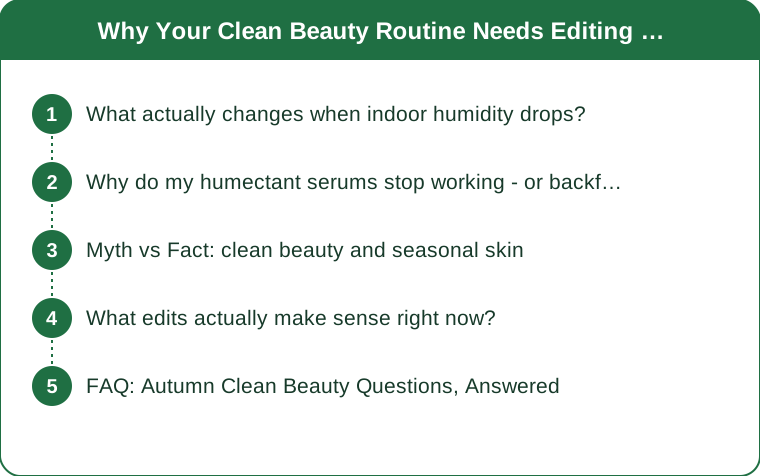
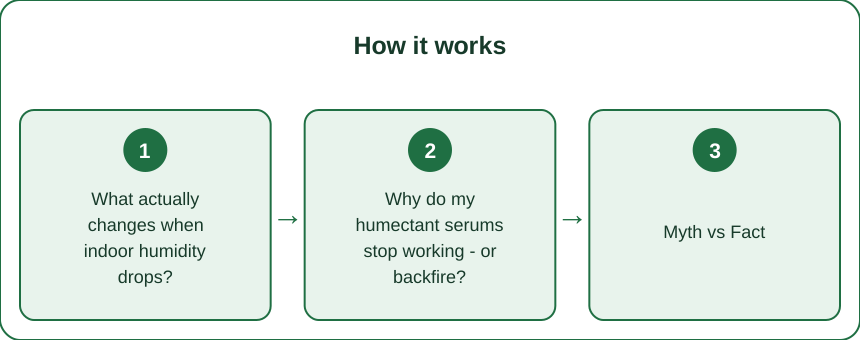
What actually changes when indoor humidity drops?
Two environments change at once, and the indoor one is harsher.
Outdoor air dries as temperatures fall. Cooler air holds less absolute moisture, so even at similar relative humidity there is less water available.
Indoor air dries dramatically once heating starts. This is the bigger effect by far. Heated indoor air in autumn and winter routinely sits at 20-30% relative humidity, and sometimes lower - comparable to desert conditions. You spend most of your day in it.
Your skin’s outer layer, the stratum corneum, exchanges moisture with the air around it continuously. The rate of transepidermal water loss rises as the surrounding air gets drier, so you lose more water passively, all day, without doing anything differently.
The practical marker to watch for is the feeling of tightness within an hour of cleansing. That is the earliest reliable sign that your barrier is losing more than your routine is replacing, and it usually shows up two or three weeks before visible flaking. Acting at the tightness stage is much easier than acting at the flaking stage.
Why do my humectant serums stop working - or backfire?
Because a humectant is a water magnet, not a water source.
Glycerin, hyaluronic acid, sodium PCA, and urea all work by binding water and holding it in the upper layers of skin. The question is always where that water comes from. In humid conditions, a meaningful share comes from the air, and the result is the plumping effect people love.
When ambient humidity falls below roughly 40%, there is much less water in the air to draw on. Applied to damp skin, humectants still work well - they hold the water you just gave them. Applied to dry skin in dry air with nothing over the top, they can draw moisture upward from deeper layers, where it then evaporates into the dry environment. The net effect can be skin that feels tighter after application than before.
This is why the same hyaluronic acid serum gets rave reviews in one climate and complaints in another. It is not a formulation quality issue.
Two rules fix almost all of it. Apply humectants to damp skin - within about 60 seconds of cleansing, while there is still water on the surface to bind. And always seal them with something occlusive or emollient on top. A humectant with no seal in dry air is the specific combination that goes wrong.
Myth vs Fact: clean beauty and seasonal skin
Myth: if a product stopped working, it was never any good. Fact: efficacy depends on the conditions of use. A lightweight gel moisturizer that was perfect in August is genuinely insufficient in a heated room in November. Same product, different environment, different result.
Myth: natural or clean formulations are inherently gentler on dry skin. Fact: gentleness depends on the specific ingredients and the formulation, not on how the product is marketed. Essential oils and botanical extracts - both common in clean lines - are among the more frequent sources of irritation for compromised barriers. A short ingredient list matters more than the label on the front.
Myth: oily skin does not need richer products in autumn. Fact: sebum and hydration are different things. Skin can be oily and dehydrated at once, and that combination often gets worse in dry air because a compromised barrier can trigger more oil production. The adjustment for oily skin is usually a better seal, not a heavier cream.
Myth: drinking more water fixes dry skin. Fact: hydration status matters for overall health, but in someone adequately hydrated, drinking additional water does not meaningfully change stratum corneum water content. The loss is happening at the surface and it is addressed at the surface.
Myth: you need an entirely new autumn routine. Fact: most people need two or three changes - seal the humectants, reduce active frequency, and adjust the cleanser. Replacing everything at once also makes it impossible to tell what helped.
What edits actually make sense right now?
Five, roughly in order of impact.
1. Add an occlusive or emollient final step. This is the highest-leverage change. Something with squalane, shea, or a plant butter applied over your existing moisturizer at night. Occlusives reduce water loss substantially, and they make everything underneath work better.
2. Change the cleanser before you change anything else. Foaming and high-pH cleansers strip lipids that are already under pressure. Moving to a cream, oil, or milk cleanser is often enough on its own to resolve early tightness - and it is the cheapest experiment available.
3. Apply to damp skin, within 60 seconds. No new product required. This single behavioral change often produces more improvement than the next serum would.
4. Reduce active frequency rather than stopping. If you use retinoids, acids, or vitamin C, dry air lowers your tolerance. Dropping from nightly to every other night, or from three times a week to twice, usually resolves irritation without giving up the benefit. Reintroduce slowly if things settle.
5. Deal with the room, not just the face. A humidifier holding indoor humidity around 40-50% addresses the cause instead of the symptom, and it helps everything from lips to eyes to sinuses. This is frequently more effective than any product change and it gets suggested last because nobody sells it as skincare.
Make one change at a time and give each one to two weeks before adding another. Skin turnover is slow enough that faster evaluation produces bad conclusions.
FAQ: Autumn Clean Beauty Questions, Answered
Should I stop using hyaluronic acid in dry weather?
No - just use it correctly. Apply it to visibly damp skin and put an emollient or occlusive over it immediately. Used that way it works well in any humidity. The failures come from applying it to dry skin and leaving it unsealed, which is a technique problem rather than an ingredient problem.
How do I tell dehydrated skin from dry skin?
Dry skin lacks oil and tends to be a persistent skin type - it feels rough, may flake, and is usually consistent year-round. Dehydrated skin lacks water and is a temporary condition any skin type can develop - it feels tight, looks dull, and fine lines appear more prominent, often improving quickly with proper hydration and sealing. Dry skin needs lipids; dehydrated skin needs water plus a seal. Many people in autumn have both.
Is a facial oil enough on its own as a moisturizer?
For most people, no. Oils are primarily emollient and occlusive - they soften and they slow water loss, but they add very little water. Used alone on dehydrated skin in dry air, an oil seals in a low moisture level rather than raising it. Layer it over a hydrating step instead, and it becomes one of the more useful products in an autumn routine.
TL;DR:
- Heated indoor air drops to 20-30% humidity, which raises transepidermal water loss all day.
- Humectants draw water from wherever they can - below 40% humidity and unsealed, they can pull it from your skin.
- Apply to damp skin within 60 seconds and always seal with an emollient or occlusive.
- Swap to a gentler cleanser, reduce active frequency, and consider a humidifier at 40-50% as the root-cause fix.
The shelf you built over summer is mostly still right - it is being asked to work in air with a fraction of the moisture it had in July. Seal what you already own, cleanse more gently, and let the room do some of the work, and you can usually get through the whole transition without replacing a single product.
Keep Reading
This article is for general informational and styling purposes only. Fit, sizing, and product availability may vary.