Why Your Natural Deodorant Stops Working After a Few Weeks
Quick Answer: Natural deodorants usually stop working for one of three reasons — your skin’s bacterial mix shifted, the weather changed how much you sweat, or a high-pH baking soda formula has started irritating skin and disrupting the barrier. Switching formula type usually fixes it faster than switching brands.
The first few weeks were genuinely impressive. Then somewhere around week four, the afternoons stopped being reliable, and you started checking.

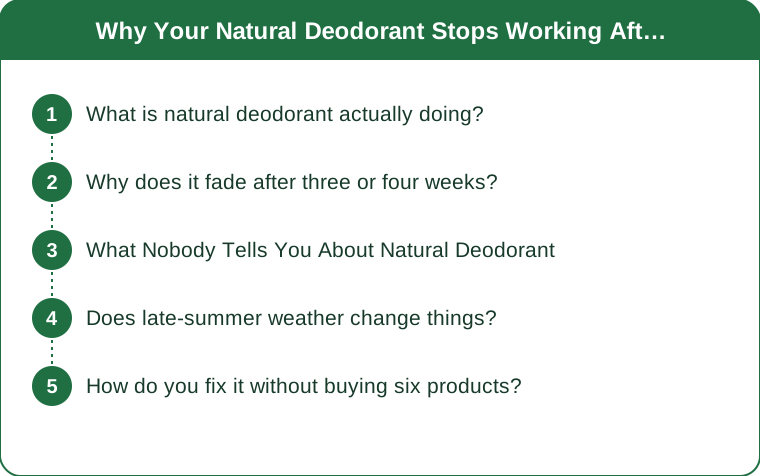
What is natural deodorant actually doing?
It is worth being precise, because it changes what to expect. Conventional antiperspirants use aluminium salts to temporarily plug sweat ducts — they reduce sweat. Deodorants, natural or not, do not reduce sweat at all. They manage odour.
Sweat itself is close to odourless. The smell comes from skin bacteria — largely Corynebacterium and Staphylococcus species — breaking down compounds in apocrine sweat.
So a natural deodorant works by some combination of: raising or lowering pH so bacteria are less comfortable, absorbing moisture with starches and clays, and adding antibacterial or fragrant botanicals.
That means performance depends on your specific skin bacteria, and those change. Which is exactly why a product can work in June and not in August.
Why does it fade after three or four weeks?
Several things converge around that mark:
Your skin microbiome shifts. When you stop using an antiperspirant, the bacterial population on your underarms rebalances over several weeks. The initial mix that your new deodorant handled well is not the mix you end up with. This is often described as an adjustment period, and it is real — but it can also settle into a community the product handles less well.
Baking soda raises skin pH. Healthy skin sits at around pH 4.7-5.5. Sodium bicarbonate is around pH 8-9. Applied daily, it can push the skin alkaline, which irritates the barrier and, over time, can favour the very bacteria you are trying to discourage.
Product buildup. Waxes, butters, and starches accumulate on skin and on clothing fibres. A saturated shirt underarm smells regardless of what you applied this morning.

What Nobody Tells You About Natural Deodorant
Your shirts hold odour independently of your skin. Synthetic fabrics especially — polyester holds odour compounds far more stubbornly than cotton, and normal washing does not always remove them. You can smell fine and your shirt can smell anyway.
Redness is a failure signal, not an adjustment. Irritation from a high-pH formula compromises the barrier, which makes everything worse. Stinging after shaving is the earliest warning.
Diet moves the needle more than people admit. Alliums, some spices, and alcohol change the compounds available to skin bacteria for a day or two afterward.
Hair holds product and bacteria. How you groom the area changes the surface area and the amount of trapped moisture, which changes how any deodorant performs.
Reapplication is normal. Nothing here is designed for sixteen hours in humid weather.
Does late-summer weather change things?
Yes, in both directions, which is why late August is a common breaking point.
Through a humid summer you sweat more and it evaporates less. More moisture on the skin means a better environment for odour-producing bacteria, and more dilution and mechanical loss of whatever you applied.
Then as the season turns, two more things change: you start layering, which traps warmth against the underarm even when the air is cool, and indoor heating begins drying skin, which makes an irritating formula bite harder than it did in July.
Practically: a formula that was adequate in May can be genuinely under-specified for a humid week in late summer, and a formula you tolerated in humidity can start stinging once the air dries out.
How do you fix it without buying six products?
Work through this in order:
- Check for irritation first. Redness, itching, dark patches, or stinging means stop the current product for a week and let the barrier recover. Do not push through.
- Switch formula type, not brand. If your product lists sodium bicarbonate high on the ingredients, try a magnesium hydroxide or zinc ricinoleate formula instead. Both manage odour without the high pH. This single swap solves the majority of cases.
- Reset your shirts. Soak underarms in a 1:4 white vinegar to water solution for 30 minutes before washing, or use an enzyme detergent. Do this once for the whole affected pile.
- Apply to clean, fully dry skin. Damp skin dilutes it immediately.
- Apply at night as well as morning. Overnight application on dry skin gives it hours to work without competing with sweat.
If odour changes suddenly and dramatically, or you have excessive sweating that interferes with daily life, that is worth raising with a professional. This is general information, not medical advice.
TL;DR:
- Deodorant manages odour-producing bacteria; it does not reduce sweat, so expectations should match.
- Fading at week three or four is usually a microbiome shift, a high-pH baking soda formula irritating skin, or buildup.
- Switch formula type — magnesium hydroxide or zinc ricinoleate — before switching brands.
- Reset your shirts with a vinegar soak; fabric holds odour independently of your skin.
Most people cycle through four brands of the same formula type and conclude natural deodorant does not work for them. It is nearly always the chemistry of the specific formula meeting the chemistry of your skin, and one deliberate swap tells you more than another six weeks of trial and error.
Keep Reading
This article is for general informational and styling purposes only. Fit, sizing, and product availability may vary.