Why Your Clean Beauty Routine Still Isn't Working (5 Overlooked Reasons)
Quick Answer: A clean beauty routine that isn’t showing results is often not a product problem - the 5 most common overlooked causes are switching everything at once (making it impossible to identify what’s working), unrealistic timelines, skipping sunscreen, using actives inconsistently, and assuming “clean” automatically means “more effective” for your specific skin concern.
You did the full clean beauty overhaul - swapped every product, read every label - and your skin looks basically the same as before. Here are the 5 overlooked reasons that gap exists, and none of them mean clean beauty doesn’t work.
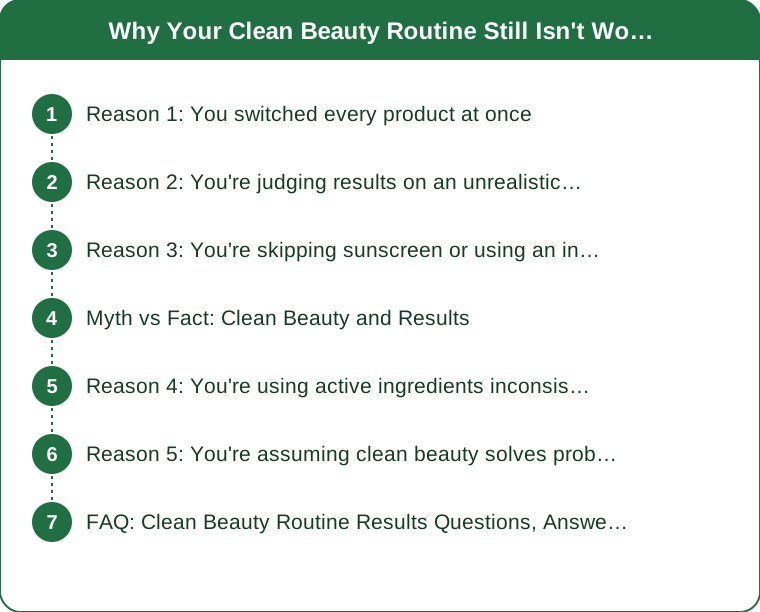
Reason 1: You switched every product at once
Replacing your entire routine simultaneously makes it impossible to identify which new product is helping, which is neutral, and which might actually be causing a new issue - like fragrance sensitivity or a mismatched formula for your skin type. When something works, you won’t know which specific product deserves credit, and when something doesn’t work, you won’t know which one to reconsider.
A staggered approach - introducing one new product every 1-2 weeks - takes longer to complete the full switch, but it gives you actual, attributable information about what’s helping your specific skin, rather than one big undifferentiated change.
Reason 2: You’re judging results on an unrealistic timeline
Meaningful skin changes from a new skincare routine typically take 4-6 weeks minimum to become visible, since skin cell turnover itself operates on roughly that cycle. Judging a new clean beauty routine after 1-2 weeks - a common pattern - is judging it before it’s had a fair chance to actually work.
This timeline applies to clean beauty just as much as any other skincare approach; “clean” formulation doesn’t accelerate the underlying biology of skin renewal, and expecting faster results specifically because a product is clean is a mismatched expectation, not a fair evaluation.
Reason 3: You’re skipping sunscreen or using an inadequate one
Sun protection is the single biggest factor in visible skin aging and evenness of tone, and it undermines nearly every other skincare effort if it’s inconsistent or inadequate. Some clean beauty mineral sunscreens require more product and more careful, even application than chemical sunscreens to reach their labeled SPF level - underapplication is a common, easy-to-miss gap specifically with mineral formulas.
If your clean beauty routine includes actives targeting dark spots, texture, or fine lines but sun protection is inconsistent, the sun exposure can actively work against the very results those other products are trying to produce, effectively canceling out progress.
Myth vs Fact: Clean Beauty and Results
Myth: “Clean” or “natural” automatically means more effective for your specific skin concern. Fact: Clean formulation is about ingredient sourcing and avoiding certain synthetic compounds - it doesn’t inherently guarantee stronger or faster results than a conventional product; effectiveness depends on the specific active ingredients and concentrations, not the clean label alone.
Myth: If a clean beauty product isn’t working within 2 weeks, it’s the wrong product. Fact: Most skincare - clean or otherwise - needs 4-6 weeks minimum to show visible change, so a 2-week judgment window is too short regardless of formulation type.
Myth: More products in a routine always means better, faster results. Fact: A routine with too many active ingredients layered together can actually cause irritation that masks or reverses progress - a simpler, more consistent routine with fewer well-chosen products often outperforms an elaborate one used inconsistently.
Reason 4: You’re using active ingredients inconsistently
Skipping days, applying irregularly, or stopping and restarting a routine repeatedly prevents the cumulative effect that most effective ingredients - clean or conventional - depend on. A vitamin C serum or a gentle retinol alternative used 2-3 times a week inconsistently for a month delivers meaningfully less benefit than the same product used consistently even at a slightly lower frequency.
Consistency matters more than product intensity for most visible skincare results - a mild, consistently used product frequently outperforms a stronger one used sporadically, which is a pattern that holds true regardless of whether the product is clean-formulated or conventional.
Reason 5: You’re assuming clean beauty solves problems it isn’t designed for
Clean formulation addresses ingredient sourcing and avoiding specific compounds some people want to avoid - it doesn’t automatically address a specific skin concern like hormonal acne, rosacea, or significant hyperpigmentation, which may need a targeted active ingredient or a dermatologist-guided approach regardless of the product’s clean status.
If your skin concern is more significant or persistent, a conversation with a dermatologist about what active ingredients (clean-formulated options exist for most categories) actually target your specific concern tends to be more productive than switching brands within the clean beauty category repeatedly, hoping a different clean product line solves it.
FAQ: Clean Beauty Routine Results Questions, Answered
How long should I actually give a new clean beauty routine before judging it?
Give it a minimum of 4-6 weeks for a fair assessment, and closer to 8-12 weeks for concerns like hyperpigmentation or texture, which change more slowly than surface hydration or immediate comfort.
Is it normal for skin to look slightly worse before it looks better when starting new products?
Some adjustment period irritation or purging (specifically with certain active ingredients like retinol alternatives or exfoliating acids) is common and usually temporary, but persistent worsening is worth reassessing rather than assuming it will resolve on its own.
Should I introduce new clean beauty products one at a time even if I’m excited to switch everything?
Yes - a staggered introduction, even though it’s slower, is the only way to actually know which products are helping your specific skin, which matters more for long-term routine building than an immediate full switch.
TL;DR:
- Switching everything at once makes it impossible to identify what’s actually working
- Give any new routine 4-6 weeks minimum before judging results
- Sunscreen consistency and coverage matters more than almost any other single step
- Clean formulation isn’t inherently more effective - active ingredient choice and consistency still matter most
A clean beauty routine that isn’t showing results usually needs a timeline check and a consistency check before it needs a product change.
Keep Reading
This article is for general informational and styling purposes only. Fit, sizing, and product availability may vary.