Why Clean Beauty Products Separate in the Bottle - and When to Worry
Quick Answer: Separation alone is often normal - many low-synthetic formulas use fewer or weaker emulsifiers and stabilisers, so oil and water phases drift apart and re-mix when shaken. It becomes a problem when separation comes with a change in smell, colour, or texture, when it will not recombine after shaking, or when the product is past its opened date. Smell is the most reliable single indicator.
You pick up the serum you bought six weeks ago and there is a clear layer sitting on top of a cloudy one. It looks broken. Sometimes it is, and often it is the formula doing exactly what a formula with fewer stabilisers does.
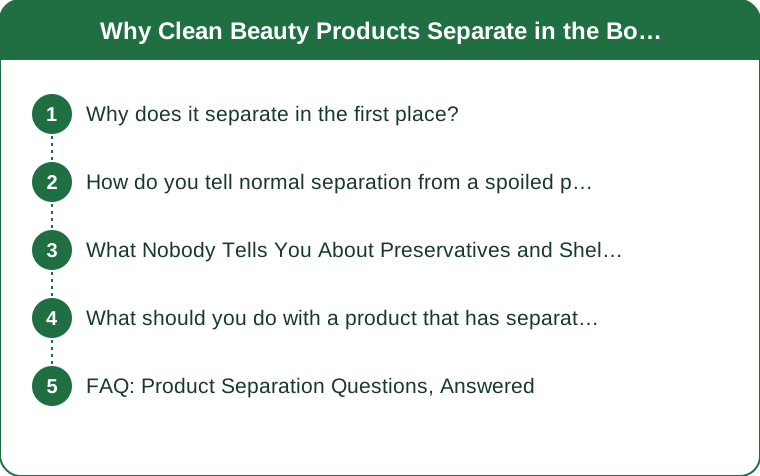
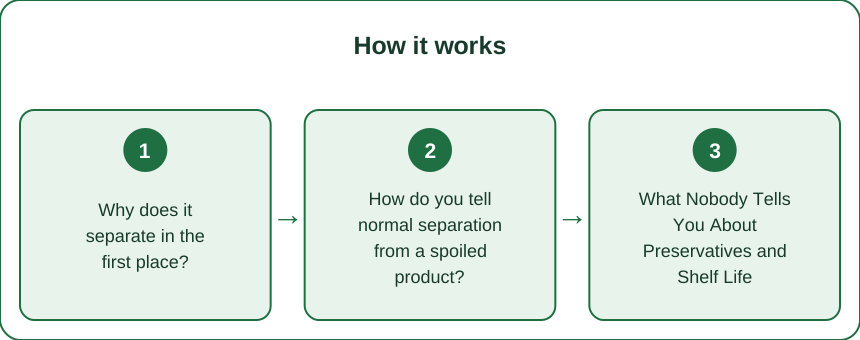
Why does it separate in the first place?
Because most skincare is an emulsion, and emulsions are inherently temporary.
An emulsion is oil and water forced into a stable mixture by an emulsifier, which reduces the surface tension between them. Left alone, oil and water always want to separate - the emulsifier is delaying an outcome rather than preventing it. The strength and quantity of emulsifier is the main thing determining how long that delay lasts, and it is one of the areas where minimally processed formulations differ most from conventional ones.
Four common reasons a product separates:
- Fewer or gentler emulsifiers. Formulas that avoid certain synthetic emulsifiers often use plant-derived alternatives that hold less aggressively. Separation is a predictable consequence rather than a defect.
- No synthetic stabilisers or thickeners. Carbomers and similar polymers hold particles in suspension. Without them, heavier ingredients settle.
- Temperature swings. Heat thins the oil phase and can break an emulsion; cold can cause waxes and butters to crystallise and drop out. A product left in a hot car or a cold windowsill is the most common culprit.
- Age. All emulsions degrade eventually. Separation appearing near the end of a product’s life is the emulsion giving up, and that is different from separation on day one.
Mineral sunscreens are the frequent special case: zinc oxide and titanium dioxide are suspended particles, and they settle by design. Nearly all of them say shake well, and nearly all of them mean it.
How do you tell normal separation from a spoiled product?
Four checks, in order of reliability.
1. Smell it. This is the most reliable single test. Rancid oils develop a distinctive sharp, waxy, crayon-like or stale-nut smell that is unmistakable once you have encountered it. Any sour, fermented, or sharply changed odour means stop using it. Fragranced products can mask early rancidity, so a subtle change matters.
2. Shake it and wait ten minutes. A normal separation recombines into a uniform texture with moderate shaking and stays combined long enough to apply. A failed emulsion either will not recombine, recombines into something grainy or curdled, or separates again within a minute.
3. Look at colour and texture. Yellowing or browning of a previously pale product suggests oxidation. Vitamin C serums are the textbook case: as they oxidise, they turn from clear or pale to yellow to orange to brown, and by brown the active has largely converted. Graininess, stringiness, or visible specks that were not there before all indicate change.
4. Check the opened date. The small open-jar symbol on the packaging with a number and an M - 6M, 12M - is the period after opening. A product with fewer preservatives is more dependent on that window being respected, not less.
Any visible mould, fizzing, a swollen container, or a lid that resists opening because of internal pressure means bin it immediately without further testing. Those indicate microbial growth, and no amount of shaking fixes that.
What Nobody Tells You About Preservatives and Shelf Life
Fewer preservatives means a shorter life, not a safer product. Preservative systems exist to prevent bacterial, yeast, and mould growth in anything containing water. A water-containing product with a weak preservative system that has been open for eight months is a genuine microbiological risk, and a contaminated product is a far greater problem than the preservative it avoided.
Anhydrous products are the exception. Oil-only serums, balms, and butters contain no water, so they do not support microbial growth and need no preservative. What they do instead is go rancid, and rancid oils are irritating to skin - which is why smell is the test that matters for them.
Jars are worse than pumps. Every time you put fingers into a jar, you introduce microbes and expose the whole product to air. Airless pumps preserve both the formula and the actives significantly better. If you have the choice with a minimally preserved product, take the pump.
The bathroom is the worst storage location in the house. Warm, humid, and subject to daily temperature swings. A bedroom drawer or a cupboard away from the shower keeps products stable for considerably longer.
And the fridge is not universally good. It helps vitamin C serums, most oils, and anything with actives that degrade with heat. It can break emulsions, harden balms, and cause some formulas to crystallise. Cold-storing everything is a common and slightly counterproductive habit - fridge the unstable actives, not the moisturiser.
What should you do with a product that has separated?
Depends which of the four categories it falls into.
Separated, smells fine, recombines fully: use it. Shake before each use and expect to keep doing that. Consider whether it is being stored somewhere warm and move it if so.
Separated and will not recombine, but smells fine: use it cautiously and quickly. A broken emulsion means the ingredients are no longer evenly distributed, so each application delivers an unpredictable ratio - which can mean an unexpectedly high dose of one component. If it is an active product, this is a reason to stop. If it is a plain moisturiser, use it up within a few weeks and watch for irritation.
Any change in smell: bin it. No exceptions, no rescuing, and do not use it on your body instead.
Discoloured active product: bin it. A brown vitamin C serum has largely lost the vitamin C, and the oxidised form is not what you paid for.
And prevent it next time. Buy smaller sizes of anything with a short window rather than the value-size version you will never finish. Store away from the shower and out of direct sun. Do a patch test on the inside of your forearm before returning to a product you have not used in months - 48 hours, and check for redness, itching, or bumps.
See a doctor or pharmacist if a product has caused a reaction that does not settle within a few days, spreads beyond the application area, or involves swelling or blistering. This is general information, not medical advice.
FAQ: Product Separation Questions, Answered
Is it normal for natural skincare to separate?
Often, yes. Formulas using fewer or gentler emulsifiers separate more readily. If it smells unchanged and recombines with shaking, it is generally fine to use.
How do you know if skincare has gone bad?
Smell is the most reliable indicator - anything sour, sharp, or crayon-like means stop. Colour change, graininess, refusal to recombine, mould, or a swollen container all mean discard it.
Should you keep skincare in the fridge?
Helpful for vitamin C, oils, and heat-sensitive actives. Not helpful for emulsions and balms, which can separate or harden. Store the rest in a cool, dry cupboard rather than the bathroom.
TL;DR:
- Separation often reflects fewer or gentler emulsifiers, not a failed product.
- Smell is the most reliable test; sharp, sour, or crayon-like means bin it.
- If it recombines with shaking and smells unchanged, it is generally fine.
- Store away from the bathroom, buy sizes you will finish, and respect the opened-date symbol.
A layer of oil on top is not automatically bad news. What your nose says about it, however, usually is.
Keep Reading
This article is for general informational and styling purposes only. Fit, sizing, and product availability may vary.