Should You Actually Switch to Fragrance-Free Skincare? Here's How to Decide
Quick Answer: Fragrance-free is worth prioritizing if you have sensitive, reactive, or eczema-prone skin, since added fragrance is one of the most common triggers for skin irritation and contact allergies — but if your skin tolerates scented products well, switching isn’t strictly necessary for general skin health.
You keep seeing ‘fragrance-free’ marketed as the automatically superior choice and you’re wondering if your current scented products are secretly a problem. The honest answer depends on how your specific skin actually responds, not a blanket rule.
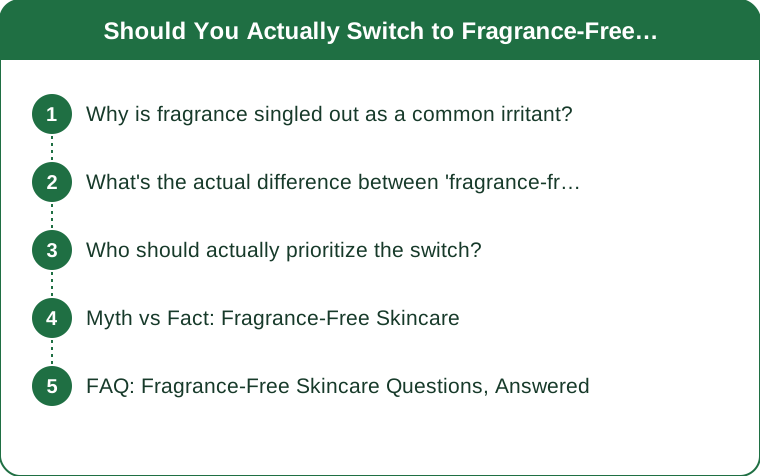
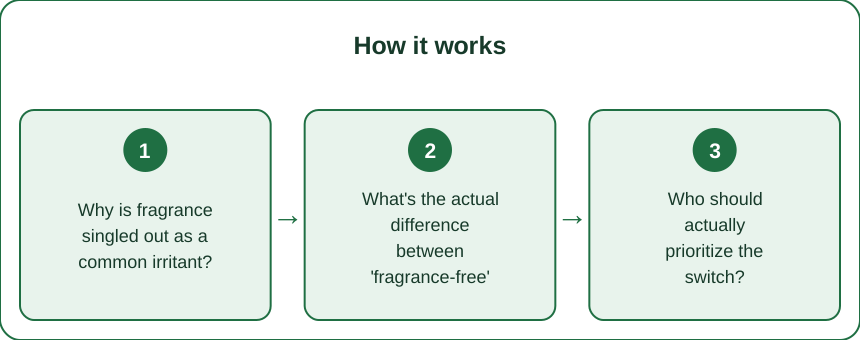
Why is fragrance singled out as a common irritant?
Added fragrance is one of the top reported causes of contact dermatitis and skin sensitization in dermatology research — a single ‘fragrance’ listed on a label can represent dozens of individual compounds, any of which could be an individual trigger.
This doesn’t mean fragrance is inherently harmful for everyone — many people use scented products with zero issues — but it explains why it’s the first ingredient category dermatologists suggest eliminating when troubleshooting unexplained irritation.
What’s the actual difference between ‘fragrance-free’ and ‘unscented’?
Fragrance-free means no fragrance ingredients, including masking fragrances, were added at all.
Unscented often means a masking fragrance was added specifically to neutralize the smell of other ingredients — so an ‘unscented’ product can still contain fragrance compounds, just not a perceptible scent. This distinction trips up a lot of people trying to eliminate fragrance and not realizing ‘unscented’ isn’t the same guarantee.
Who should actually prioritize the switch?
- Anyone with eczema, rosacea, or generally reactive/sensitive skin
- People experiencing unexplained redness, stinging, or breakouts with no other clear cause
- Those with a known fragrance allergy or sensitivity diagnosed by a dermatologist
- Anyone using products on already-compromised skin (post-procedure, actively irritated, very dry/cracked)
If none of these apply and your skin has always tolerated scented products fine, fragrance-free isn’t a required upgrade — it’s simply one more option.
Myth vs Fact: Fragrance-Free Skincare
Myth: Natural fragrance (essential oils) is automatically safer than synthetic fragrance. Fact: Natural fragrance compounds can be just as irritating or sensitizing as synthetic ones — ‘natural’ doesn’t mean lower reaction risk.
Myth: Fragrance-free products are less effective. Fact: Fragrance has no role in a product’s active efficacy — removing it doesn’t change how well moisturizing or active ingredients perform.
Myth: If you’re not currently reacting, fragrance definitely isn’t affecting your skin. Fact: Fragrance sensitization can build gradually with repeated exposure — some people develop a reaction to a product they’d used without issue for years.
FAQ: Fragrance-Free Skincare Questions, Answered
How do I know if fragrance is actually causing my irritation?
A patch test or an elimination period — switching to fragrance-free products for several weeks and watching for improvement — is the most reliable way to isolate fragrance as the cause versus another ingredient.
Do I need to switch every product, or just some?
Start with leave-on products (moisturizer, serum) since they have longer skin contact time than rinse-off products like cleanser, where fragrance exposure is much briefer.
Is fragrance-free skincare necessary for everyone?
No — it’s most relevant for sensitive or reactive skin; if your skin has always tolerated scented products without issue, it’s a personal preference rather than a necessity.
TL;DR:
- Added fragrance is one of the most common triggers for skin irritation and contact allergies
- ‘Unscented’ isn’t the same as fragrance-free — it can still contain masking fragrance
- Sensitive, reactive, or eczema-prone skin benefits most from prioritizing the switch
- Natural fragrance isn’t inherently safer than synthetic — both can sensitize skin
The switch is most worth making based on how your skin actually responds, not because fragrance-free is universally superior.
Keep Reading
This article is for general informational and styling purposes only. Fit, sizing, and product availability may vary.