How to Read an Ingredient List Without a Chemistry Degree
Quick Answer: Ingredients are listed in descending order by concentration down to 1 percent, after which they can appear in any order. That single rule tells you most of what you need - anything appearing after the preservatives or fragrance is present in small amounts, regardless of how prominently it features on the front of the bottle.
The front of the packaging is marketing. The back is a regulated document, and it is considerably more informative once you know how it is ordered.
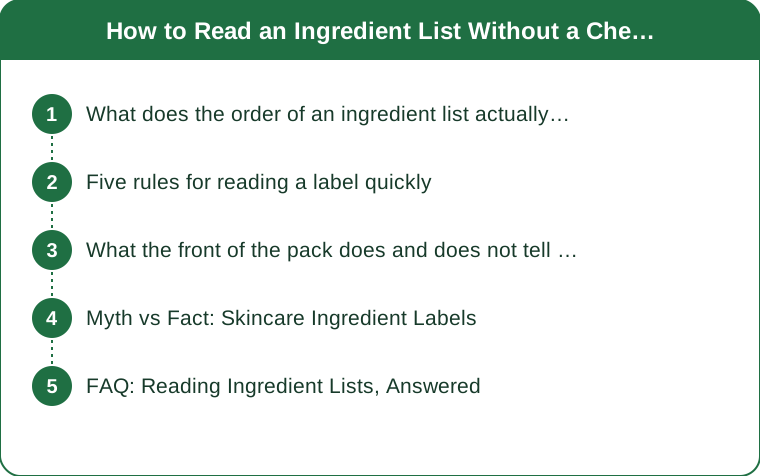
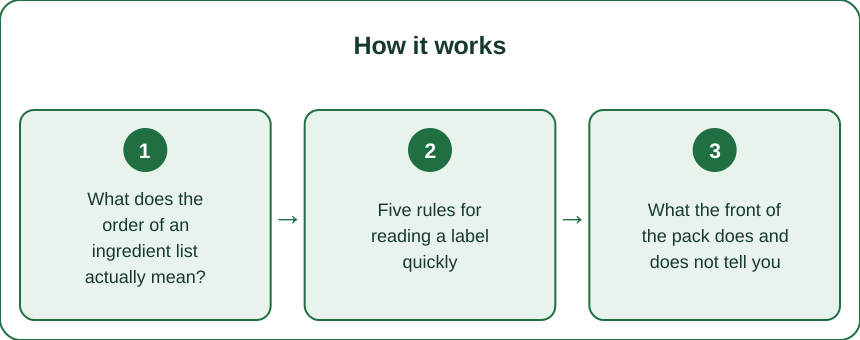
What does the order of an ingredient list actually mean?
It is a concentration ranking, and it stops being one partway down.
The rule: ingredients must be listed in descending order of concentration down to 1 percent. Below 1 percent, they may be listed in any order. Colourants are typically listed last regardless.
Why this is the most useful thing on the label: it lets you estimate roughly where the 1 percent line falls, and therefore whether a heavily advertised ingredient is present in a meaningful amount.
How to find the 1 percent line, approximately:
- Look for common preservatives - phenoxyethanol is typically used at up to about 1 percent
- Look for fragrance or parfum, usually below 1 percent in leave-on products
- Look for xanthan gum, carbomer, or sodium hydroxide - thickeners and pH adjusters used at fractions of a percent
- Anything after those is almost certainly below 1 percent
What that tells you in practice:
- A ‘niacinamide serum’ with niacinamide listed after phenoxyethanol contains a token amount. Effective niacinamide concentrations are typically in the 2 to 10 percent range.
- A ‘botanical extract’ at the end of the list is present in trace quantities - which is not necessarily a problem, just not the active story
- The first five ingredients are most of the product. If those are water, glycerin, a couple of emollients and a thickener, you are largely buying a moisturiser.
An important caveat: low concentration does not mean useless. Some actives work at very low percentages - retinoids, certain peptides - and some ingredients are deliberately used at low levels for irritation reasons. The rule tells you what is present, not what works.
Five rules for reading a label quickly
Rule 1: Read the first five ingredients. These make up the bulk of the formula and determine its basic character - whether it is a lightweight gel, a rich cream, or mostly water with a thickener.
Rule 2: Locate the 1 percent line and see which side your active is on. This is the single highest-value check, and it takes about ten seconds once you know what to look for.
Rule 3: Recognise that ‘natural’ and ‘chemical’ are not meaningful safety categories. Everything is a chemical, and plant extracts are among the most common causes of contact allergy in cosmetics. Essential oils in particular - citrus oils, lavender, and their oxidation products - are well-documented sensitisers. The origin of an ingredient tells you nothing reliable about how your skin will respond to it.
Rule 4: Check for the things you already know irritate you, rather than scanning for a general danger list. Individual reactivity varies enormously, and a personal list is far more useful than a generic one. Common culprits: fragrance, essential oils, high concentrations of alcohol denat in leave-on products, and certain preservatives.
Rule 5: Note the packaging, not just the formula. Retinoids, vitamin C and many antioxidants degrade with light and air exposure. An active in a clear jar is a formulation decision that undermines the active. Opaque, airless packaging is a genuine quality signal and costs the brand money.
A bonus rule for anyone with sensitive skin: shorter lists are not automatically gentler, but they are easier to troubleshoot. If you react to a 30-ingredient product, identifying the cause is very hard. A simpler formula makes elimination practical.
What the front of the pack does and does not tell you
Front-of-pack claims sit in a range from strictly regulated to entirely unregulated, and the difference is not obvious.
Terms with no standard definition in most markets:
- ‘Clean’ - no legal definition anywhere. It means whatever the brand’s own standard says.
- ‘Natural’ - largely unregulated, and there is no threshold percentage required in most jurisdictions
- ‘Non-toxic’ - not a meaningful regulatory category for cosmetics, which are already required to be safe as sold
- ‘Chemical-free’ - not physically possible
- ‘Dermatologist tested’ - means a dermatologist was involved in some test. It does not specify the test, the size, or the result.
Terms with more substance:
- ‘Non-comedogenic’ - has a testing basis, though methods vary and results do not always predict real-world behaviour
- ‘Hypoallergenic’ - loosely regulated, generally meaning reduced allergen content, but standards vary by market
- ‘Fragrance-free’ versus ‘unscented’ - these differ meaningfully. Unscented can contain masking fragrance; fragrance-free should not contain added fragrance.
- Certification marks - organic and cruelty-free certifications have defined published standards, unlike self-declared claims
Where the actual regulation sits: cosmetics are subject to safety requirements and ingredient restrictions in most major markets, with published lists of banned and restricted substances. A product legally sold has met those requirements regardless of what the front of the pack claims about being cleaner than the alternative.
The practical position: use front-of-pack claims to understand what a brand is going for, and the back of the pack to understand what you are buying. If you have a specific medical skin concern, a dermatologist is the appropriate resource - this is general information, not medical advice.
Myth vs Fact: Skincare Ingredient Labels
Myth: Ingredients are listed in order of importance. Fact: they are listed by concentration, down to 1 percent. A critical active can appear near the end because it works at a low percentage - and a useless one can appear there too. Position tells you quantity, not significance.
Myth: A long ingredient list means a lower-quality product. Fact: list length reflects formulation complexity, not quality. Emulsifiers, stabilisers and preservatives all take up space and all do necessary jobs. Some excellent formulas are long; some poor ones are short.
Myth: Preservative-free is safer. Fact: water-containing products without adequate preservation grow bacteria and mould. Microbial contamination is a genuine safety risk, particularly for anything used near the eyes. Preservatives are the reason cosmetics are safe over a three-month use period.
Myth: Natural ingredients are gentler. Fact: botanical extracts and essential oils are among the more common causes of cosmetic contact allergy. Citrus and lavender oils oxidise into more sensitising compounds over time. Origin is not a predictor of tolerance.
Myth: If it is on the front, there is a meaningful amount inside. Fact: a trace of an ingredient is enough to name it on the front of the pack. Checking whether it appears before or after the preservatives is the whole test, and it takes seconds.
FAQ: Reading Ingredient Lists, Answered
How do I know if an active is at an effective concentration?
Find the 1 percent line - usually around the preservative or fragrance - and see which side the active sits on. Brands that are confident about concentration often state it on the pack.
Does ‘clean beauty’ mean anything specific?
No. There is no legal definition, so each brand sets its own standard. It describes a positioning rather than a verified property.
Are parabens actually a problem?
They remain permitted at restricted concentrations in major markets after extensive review. Avoiding them is a reasonable personal choice, but products using them are not sold outside the safety framework.
What is the difference between fragrance-free and unscented?
Fragrance-free should contain no added fragrance. Unscented can contain masking fragrance to neutralise a base odour - relevant if fragrance is your trigger.
Should I be worried about a long ingredient list?
Not in itself. Longer lists are harder to troubleshoot if you react, which is the main practical downside for sensitive skin. Speak to a dermatologist about persistent reactions - this is general information, not medical advice.
TL;DR:
- Ingredients are listed by concentration down to 1 percent, then in any order
- Find the 1 percent line at the preservative or fragrance and see which side your active is on
- The first five ingredients are most of the product
- ‘Clean’, ‘natural’ and ‘non-toxic’ have no standard definitions; ‘fragrance-free’ does
- Packaging matters - light-sensitive actives in clear jars are a formulation compromise
Thirty seconds on the back of the bottle tells you more than any amount of front-of-pack language. First five ingredients, then find the 1 percent line.
Keep Reading
This article is for general informational and styling purposes only. Fit, sizing, and product availability may vary.