Kitchen Beauty: What's Actually Safe to DIY (and What to Leave to Chemists)
Quick Answer: Safe to DIY: colloidal oatmeal baths, sugar-and-oil body scrubs, honey as a short mask, and plain oils for body moisture. Genuinely dangerous: lemon juice on skin (phototoxic burns), baking soda (destroys your skin barrier’s pH), cinnamon masks, and any homemade sunscreen. Everything in between is mostly harmless and mostly pointless — the avocado can’t get through your skin barrier, and it was better in the smoothie.
There’s a line running through the middle of DIY beauty, and it’s not where people expect.
On one side: grandma’s oatmeal bath, which dermatologists prescribe in commercial form and which genuinely works. On the other: a lemon juice toner tutorial with 4 million views and a comment section full of people describing chemical burns in a rustic aesthetic.
Same category. Wildly different outcomes. Here’s the honest map — what works, what wastes an avocado, and what genuinely needs a chemist.

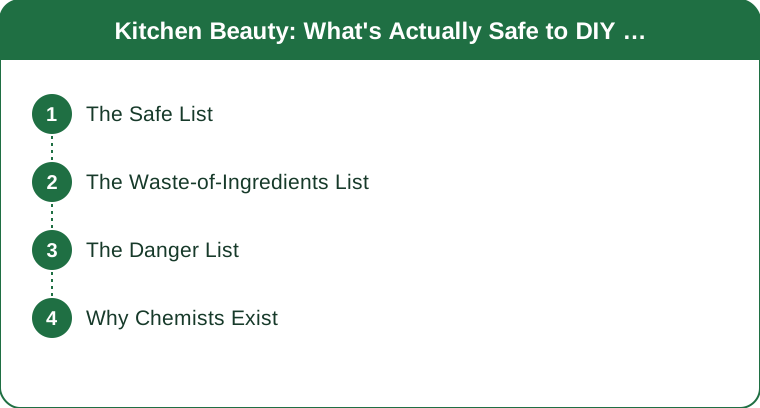
Which DIY Beauty Treatments Actually Work?
Four, and they all share a quality: simple mechanism, no active chemistry required.
Colloidal oatmeal baths. This one has real pharmacology behind it — colloidal oatmeal is an FDA-recognized skin protectant, and it genuinely calms itching and irritation from eczema, sunburn, and general reactivity. Grind plain oats in a blender until they’re a fine powder that disperses in water rather than sinking. About one cup in a lukewarm bath, soak 10–15 minutes, pat dry, moisturize immediately. Grandma was right, and the research agrees with her.
Sugar-and-oil body scrubs. Physical exfoliation doesn’t require formulation — sugar is an abrasive, oil is a lubricant, that’s the whole product. Roughly 2 parts sugar to 1 part olive or coconut oil. Body only, never face — facial skin is thinner and sugar crystals are too coarse for it.
Honey as a short face mask. Honey is humectant, mildly antibacterial, and unlikely to cause problems. Ten to fifteen minutes, rinse warm. It won’t clear acne or change your skin structurally, but it’s pleasant and it does hydrate briefly.
Plain oils for body moisture. Jojoba, sweet almond, olive on damp skin after a shower. Simple, effective, and cheaper than the version with a label on it. Skip coconut oil on the face if you’re acne-prone — it’s comedogenic for a lot of people.
What DIY Beauty Is Just a Waste of Ingredients?
The produce-on-the-face genre. Avocado masks, banana treatments, cucumber puree, mashed papaya.
These are harmless, pleasant, and mostly futile. The molecules in an avocado are far too large to cross the stratum corneum — your skin’s outer barrier is specifically designed to keep things like that out, and it’s very good at its job. What you’re feeling is the moisture and the oil sitting on the surface, which is real but temporary and which a $6 moisturizer does better.
Fine as ritual. Genuinely nice as a twenty-minute excuse to lie down. Futile as treatment.
The smoothie needed that avocado more than your face did.

What DIY Beauty Is Actually Dangerous?
Four things, and the first one lands people in dermatology offices every single summer.
Lemon juice on skin. Citrus contains furocoumarins, which are phototoxic — they react with UV light and cause genuine chemical burns, often in the exact drip pattern of however you applied it. The condition has a name, phytophotodermatitis, and dermatologists see the margarita version of it every July. The resulting hyperpigmentation can last months. Lemon juice is also around pH 2, which is destructive to your skin barrier before sunlight is even involved. Citrus belongs in drinks.
Baking soda scrubs and masks. Baking soda is pH 9. Healthy skin sits around pH 4.7–5.5, slightly acidic for a reason — that acid mantle is part of your barrier function and your microbiome’s operating environment. Repeatedly alkalizing it causes dryness, irritation, and increased sensitivity that can take weeks to recover from.
Cinnamon masks. Extremely viral, reliably inflammatory. Cinnamon is a known contact irritant and sensitizer. The “tingling” people report as proof it’s working is the sensation of irritation.
DIY sunscreen. This one is safety-critical, not just inadvisable. Homemade zinc oxide mixtures cannot be tested for even dispersion or actual SPF, and an unevenly mixed batch gives you patchy protection you’re trusting with skin cancer risk. There is no home version of this. Buy the sunscreen.
If any DIY treatment stings, burns, or leaves skin red for more than a few minutes, rinse it off. And if you have eczema, rosacea, or any diagnosed skin condition, run kitchen experiments past a dermatologist first — reactive skin has a much narrower safe range than the internet assumes.

Why Can’t You Just Make Skincare at Home?
Three things a kitchen cannot supply, and all three are the reason formulated products cost what they do.
Precise concentrations. Actives work in narrow windows. Vitamin C needs to be around 10–20% at a low pH to penetrate meaningfully; below that it does nothing and above it just irritates. You cannot eyeball that with a spoon.
Stability. Vitamin C oxidizes fast — a homemade jar in your fridge is measurably degraded within days and visibly brown within a week or two. Retinoids degrade in light. Formulated products use chelators, antioxidants, and opaque packaging to fight this, and it’s most of the engineering.
Preservation. Anything water-based grows bacteria and mold, quickly. A preservative-free DIY moisturizer develops a microbiome you did not order, usually before you can see it. That’s the single biggest safety gap in homemade skincare, and it’s invisible.
Kitchen for the gentle mechanical stuff. Lab for anything claiming a result.
Myth vs Fact: Kitchen Skincare
Myth: If you can eat it, it’s safe to put on your face. Fact: Your stomach has an acid environment and a robust lining; your face has a thin barrier and none of those defenses. Lemon is the clearest example of something perfectly edible and genuinely damaging on skin.
Myth: DIY skincare is always gentler than store-bought. Fact: Gentleness comes from pH, concentration, and formulation — all of which a commercial lab controls and a kitchen doesn’t. A homemade scrub can be considerably harsher than a formulated exfoliant.
Myth: Coconut oil is a universal skincare product. Fact: It’s a good body moisturizer and comedogenic for a lot of people on the face. It’s also not a cleanser, a sunscreen, or a treatment for anything, despite a decade of internet claims to the contrary.
Myth: Adding a preservative would ruin a “clean” homemade product. Fact: Preservatives are the reason water-based products don’t grow mold. A preservative-free DIY moisturizer isn’t cleaner — it’s just contaminated on a shorter timeline.
Mini FAQ
Is DIY skincare cheaper than buying products?
For scrubs and oils, yes, meaningfully — you’re paying for ingredients rather than packaging. For anything with actives, no. You’ll spend more on ingredients that degrade before you use them than a formulated product would have cost, and it won’t work as well.
Are natural ingredients safer than synthetic ones?
Not inherently. Poison ivy is natural; lemon juice causes chemical burns; essential oils are among the most common contact allergens in cosmetics. “Natural” describes an origin, not a safety profile. Judge ingredients by what they do, not where they came from.
Can I use food-grade ingredients on my face?
Edible and skin-safe are different standards. Your stomach has a strong acid environment and a robust lining; your face has a thin barrier and no equivalent defenses. Plenty of things you can eat safely will irritate skin, and lemon is the clearest example.
TL;DR:
- Safe and worth doing: colloidal oatmeal baths, sugar-and-oil body scrubs, honey masks, plain oils on damp skin.
- Harmless but pointless: avocado, banana, and cucumber masks — the molecules can’t get through your skin barrier.
- Genuinely dangerous: lemon juice (phototoxic burns), baking soda (pH damage), cinnamon (irritant), DIY sunscreen (untestable SPF).
- Home kitchens can’t control concentration, stability, or preservation — which is exactly what formulated products are for.
- Natural describes origin, not safety. Judge by mechanism.
Oats and sugar scrubs in, lemon and soda and homemade SPF out, avocado optional but better in the smoothie. Grandma’s greatest hits hold up fine — the danger was always the tutorials that skipped chemistry class.
Keep Reading
This article is for general informational and styling purposes only. Fit, sizing, and product availability may vary.