Is 'Clean' Deodorant Actually Worse at Stopping Odor Than Regular Antiperspirant?
Quick Answer: Clean deodorant controls odor but doesn’t stop sweat like an aluminum antiperspirant does — and most people go through a 1-3 week adjustment period where it genuinely underperforms before their body recalibrates.
You switched to a clean deodorant because the ingredient list felt better, and now it’s 2pm and you’re wondering if you smell. That gap between intention and reality is real, and there’s a specific, well-documented reason for it — not a sign the whole clean beauty category is a scam.

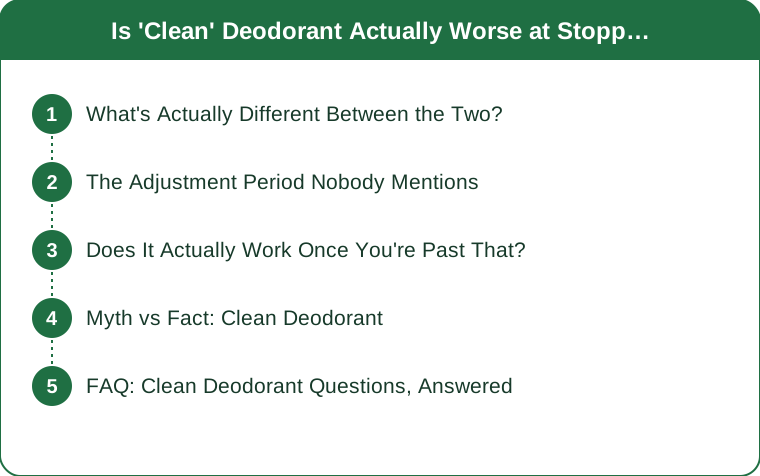
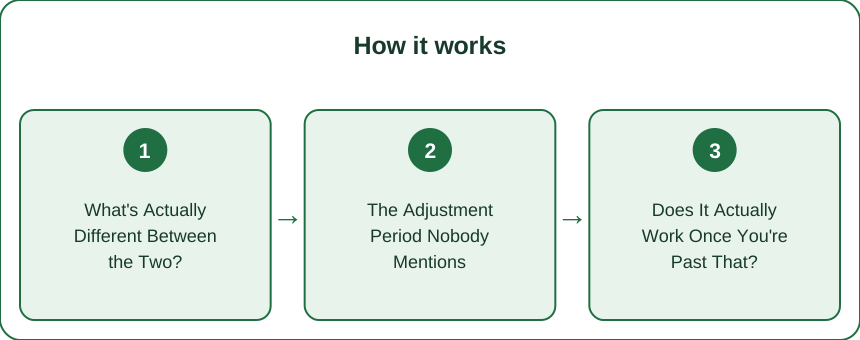
What’s Actually Different Between the Two?
Regular antiperspirant uses aluminum compounds to physically plug sweat ducts, which stops moisture from reaching the surface at all — no sweat means no odor-causing bacteria breeding ground on the skin’s surface. Clean deodorant doesn’t block sweat; it only targets the bacteria that cause odor once sweat is already on the skin. That’s a fundamentally different job, and it’s why the two aren’t directly interchangeable, no matter how similar they look sitting side by side on a shelf.
This distinction also explains why some people report feeling ‘wetter’ after switching, even when their actual odor is well controlled — the sensation of moisture and the presence of odor are two separate things that antiperspirant happens to solve together and clean deodorant only solves one of.
The Adjustment Period Nobody Mentions
When you stop using an aluminum antiperspirant, sweat glands that were chemically plugged reopen, and many people experience a temporary uptick in sweat and odor for roughly 1 to 3 weeks as the skin’s bacterial balance resets. This isn’t the clean deodorant failing — it’s a detox-adjacent adjustment period, and quitting during week one is the most common reason people conclude ‘clean deodorant doesn’t work for me’ before ever giving it a fair test.
The underarm microbiome itself also shifts during this window: years of antiperspirant use suppresses certain bacterial populations, and once that suppression lifts, the skin’s bacterial ecosystem needs time to rebalance into whatever its new normal will be — this rebalancing is part of what drives the temporary odor increase, not a permanent state.

Does It Actually Work Once You’re Past That?
Past the adjustment window, a well-formulated clean deodorant with ingredients like arrowroot or tapioca starch (for moisture absorption) and antibacterial agents like coconut oil or tea tree can control odor comparably well for light-to-moderate sweat days. It genuinely does not perform the same for heavy exercise or high-heat days, where sweat volume overwhelms an odor-only formula rather than a moisture-blocking one.
Formulation quality varies a lot within the ‘clean’ category too — some rely mainly on baking soda for odor control, which works well for many people but can cause irritation or a rash for those with sensitive underarm skin, while baking-soda-free formulas using magnesium hydroxide instead tend to be gentler but sometimes slightly less effective at pure odor control.
Myth vs Fact: Clean Deodorant
Myth: ‘natural’ automatically means it works as well as antiperspirant. Fact: it solves a different problem (odor, not moisture) and needs to be judged on that basis, not compared 1:1 against a product designed to stop sweat outright.
Myth: if it’s not working, you just have the wrong brand. Fact: often it’s the adjustment period, application amount (clean formulas typically need more product per application than antiperspirant, since there’s no aluminum concentrating the active ingredient), or reapplication timing (midday reapply matters more with clean formulas) rather than the formula itself being defective.
Myth: you have to choose one type forever once you switch. Fact: the skin’s sweat ducts and microbiome adapt in both directions — switching back to antiperspirant after a stint with clean deodorant works fine, and many people move between the two seasonally or based on how demanding a given day is.
FAQ: Clean Deodorant Questions, Answered
How long should I give a clean deodorant before deciding it doesn’t work?
At least 2-3 full weeks of consistent daily use to get past the detox-adjustment window before judging effectiveness — judging it during week one is judging the adjustment period, not the product itself.
Can I use clean deodorant on heavy workout days and antiperspirant the rest of the time?
Yes — many people run a hybrid approach, using antiperspirant for intense workout days and clean deodorant for lower-activity days, with no issue switching back and forth, since the sweat ducts don’t require exclusive long-term commitment to one type to function normally.
Does clean deodorant stain clothes less than antiperspirant?
Generally yes, since aluminum compounds are the primary cause of the yellow underarm stains associated with antiperspirant buildup reacting with sweat proteins on fabric over repeated washes.
Why does my skin feel irritated after switching to a clean deodorant?
Baking-soda-based formulas are the most common irritation trigger, especially for underarm skin that’s more alkaline-sensitive than average — switching to a baking-soda-free formula using magnesium hydroxide or a different odor-control base often resolves it without giving up on clean deodorant entirely.
TL;DR:
- Clean deodorant fights odor; antiperspirant blocks sweat — they solve different problems
- Expect a 1-3 week adjustment period of extra sweat and odor after switching
- Past that window, it holds up fine for light-to-moderate days, less so for heavy workouts or heat
- Formulation matters — baking-soda-based formulas are more effective for some but irritating for others
- A hybrid approach (antiperspirant for intense days, clean for the rest) works for a lot of people
Switching to clean deodorant isn’t a downgrade so much as a different tool — give it the full adjustment window and, if irritation shows up, try a different formulation before deciding whether it earns a permanent spot in your routine.
Keep Reading
This article is for general informational and styling purposes only. Fit, sizing, and product availability may vary.