Why Clean Beauty Products Expire Faster — and How to Not Waste Money on Them
Quick Answer: Most clean beauty products with minimal preservatives last 6-12 months once opened, versus 18-24 months for conventional formulas. Store them in the fridge or a dark cabinet, and buy smaller sizes so you actually finish the jar before it turns.
You paid more for the clean version, then found it separated or smelled off after four months. That’s not a defective batch — it’s a predictable tradeoff of the ingredients you chose, and there’s a real way to work around it.
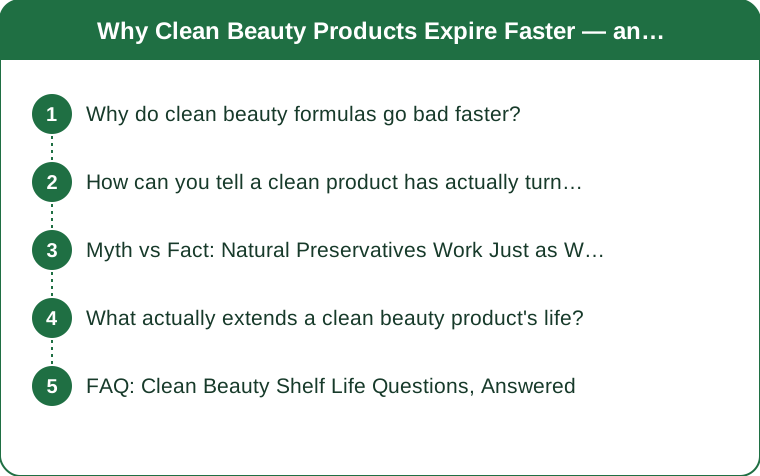
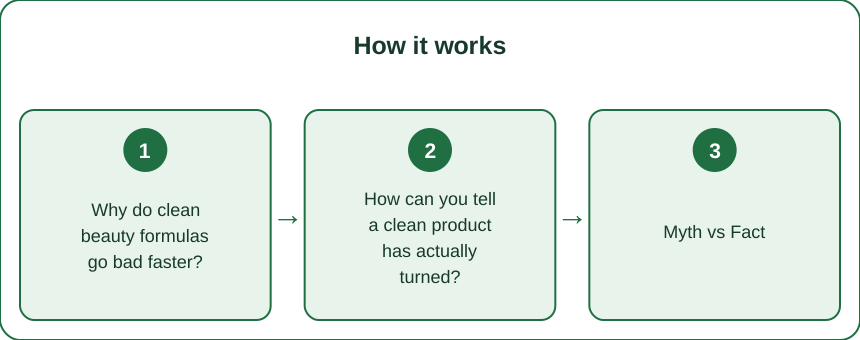
Why do clean beauty formulas go bad faster?
Fewer synthetic preservatives means less protection against bacteria, mold, and oxidation once the product is opened and exposed to air and your fingers repeatedly. This isn’t a flaw — it’s the direct tradeoff for skipping parabens and formaldehyde-releasers.
Water-based formulas (serums, gel moisturizers) degrade fastest; oil-based balms and anhydrous products (no water) last considerably longer since bacteria need water to grow.
How can you tell a clean product has actually turned?
Watch for separation that doesn’t remix when shaken, a sour or rancid smell replacing the original scent, a color shift (a white cream turning yellow), or a texture change like a serum turning gritty.
If any of these show up before the period-after-opening (PAO) symbol on the jar says it should, don’t push through it — using expired actives can irritate skin rather than help it.
Myth vs Fact: Natural Preservatives Work Just as Well
Myth: “Naturally preserved” means it lasts as long as conventional products. Fact: Natural preservative systems (like radish root ferment) genuinely help, but rarely match synthetic broad-spectrum preservatives for shelf stability — expect shorter windows, not equal ones.
Myth: Refrigeration is just a marketing gimmick. Fact: Cold measurably slows both oxidation and microbial growth — it’s one of the few free extensions of a preservative-light product’s usable life.
What actually extends a clean beauty product’s life?
Keep it out of the bathroom humidity — store in a bedroom drawer or the fridge instead of a steamy shower shelf. Use a spatula, not fingers, for jar products to avoid introducing bacteria with every use. Buy smaller sizes deliberately, even at a slightly higher per-ounce cost — a $22 mini you finish beats a $40 jar you toss half-used.
FAQ: Clean Beauty Shelf Life Questions, Answered
Does clean beauty need to be refrigerated?
Not always required, but vitamin C serums, gel textures, and anything without added preservatives benefit most from a fridge shelf.
Is it safe to use a clean product past its PAO date if it still smells fine?
Smell isn’t a reliable safety test alone — mold and bacterial growth aren’t always detectable by nose. When in doubt, replace it.
Do clean beauty brands print expiration dates?
Many use the PAO jar symbol (a small open-jar icon with a number like “6M”) instead of a fixed date — check for that symbol on the packaging.
TL;DR:
- Clean formulas last 6-12 months open vs. 18-24 for conventional — that’s the tradeoff, not a defect
- Separation, sour smell, or gritty texture before the PAO date means toss it
- Fridge storage and a spatula (not fingers) meaningfully extend usable life
- Buy smaller sizes so you finish the jar before it turns
Keep Reading
This article is for general informational and styling purposes only. Fit, sizing, and product availability may vary.