Your Clean Beauty Routine Needs Two Changes When Humidity Drops
Quick Answer: When ambient humidity falls, two things change: humectant-heavy products can pull moisture from your skin rather than the air, and your skin’s barrier loses water faster overall. The two adjustments that matter are sealing humectants with an occlusive or emollient layer, and reducing exfoliation frequency. Everything else - seasonal product lines, autumn-specific formulas - is largely marketing.
The serum that absorbed beautifully in August now sits on top and balls up under sunscreen. Nothing about the product changed.
Here’s what actually shifts when the air dries out, and the two adjustments worth making.
This is general information, not medical advice. Persistent irritation, painful cracking, or a rash warrants seeing a dermatologist.
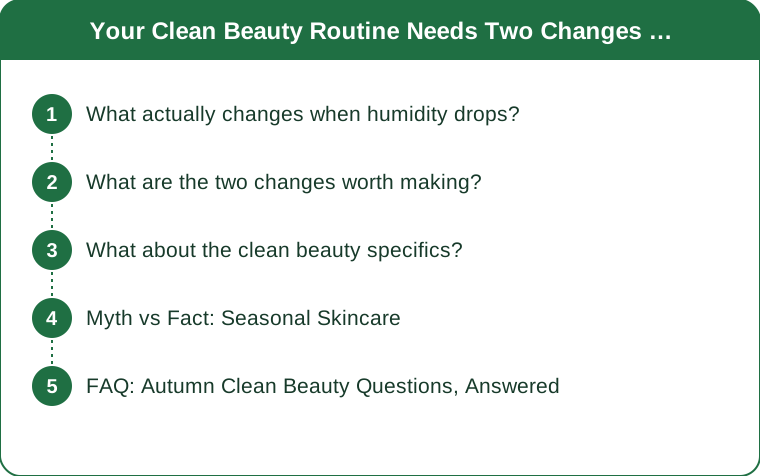
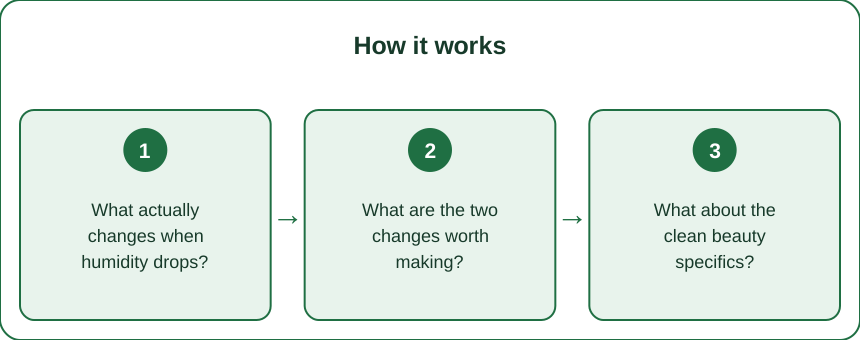
What actually changes when humidity drops?
Two mechanisms, and one of them is genuinely counter-intuitive.
1. Humectants can work backwards in dry air. Humectants - glycerin, hyaluronic acid, honey, aloe, urea - draw water toward the skin’s surface. In humid conditions they pull from the air. In dry conditions there’s less available in the air, and they can draw water from the deeper layers of your own skin instead, where it then evaporates.
This is why a hyaluronic acid serum that felt hydrating in July can leave skin feeling tighter in October if it’s used without something sealing it in.
The fix isn’t to stop using humectants - they’re genuinely useful. It’s to always follow them with an emollient or occlusive layer that slows the water leaving. Apply the humectant to damp skin, then seal.
2. Transepidermal water loss increases. Your skin loses water continuously through the barrier. The drier the air, the steeper the gradient and the faster the loss. Colder air holds less moisture, and indoor heating - once it starts - is drier still.
The visible consequences, in order of appearance:
- Tightness after cleansing - the earliest signal
- Makeup clinging to dry patches
- Products pilling - usually because the previous layer hasn’t fully absorbed into skin that’s no longer taking it up the same way
- Increased sensitivity to actives that were fine all summer
Both mechanisms point to the same conclusion: the routine doesn’t need new products. It needs a sealing step and less exfoliation.
What are the two changes worth making?
Change 1: Add or upgrade the sealing layer.
The order that works: cleanse, then humectant on damp skin, then emollient or occlusive, then sunscreen in the morning.
Emollients smooth and fill gaps between skin cells - squalane, jojoba, shea butter, fatty alcohols. These do the bulk of the work for most people.
Occlusives form a physical barrier that slows evaporation - petrolatum, beeswax, lanolin, certain plant butters. More effective and heavier; useful at night or on specific dry areas.
Clean-beauty-friendly options that work: squalane oil, shea butter, jojoba, a rich cream with a plant butter high in the ingredient list. Applying to slightly damp skin roughly doubles the benefit because you’re sealing in water that’s already there.
Change 2: Cut exfoliation frequency, at least in half.
The single most common autumn skincare mistake is maintaining a summer exfoliation schedule into drier weather. Summer’s oil production and humidity tolerated frequent acid use; autumn doesn’t.
Practical adjustment: if you were exfoliating three times a week, drop to once or twice. If you’re using a leave-on acid daily, that’s the thing to change first.
How to tell you’re over-exfoliating: tightness, stinging on product application, increased redness, and skin that looks shiny but feels rough. That shine is often barrier damage rather than hydration - it’s the most misread signal in skincare.
What you don’t need: an entirely new autumn routine, a seasonal product line, or anything marketed specifically as a weather-transition product. Two changes to what you already own covers the great majority of it.
What about the clean beauty specifics?
Three considerations that apply particularly to natural-leaning formulas.
Preservative systems and seasonal storage. Products with minimal or plant-based preservative systems have shorter useful lives and are more sensitive to temperature. Anything that spent the summer in a hot bathroom or a car has likely degraded, and this affects clean formulations more than heavily preserved ones.
What to check: separation, colour change, an off or rancid smell, or a texture change. Plant oils high in unsaturated fats - rosehip, evening primrose - go rancid relatively quickly, and a rancid oil is irritating rather than just useless. Check the period-after-opening symbol and be honest about when you opened it.
Essential oils become more irritating on a compromised barrier. Many natural fragrance components are recognised sensitisers. On intact summer skin they may cause no reaction; on a dry, barrier-compromised autumn face the same product can sting. If something that was fine now stings, fragrance is the first ingredient to suspect.
Mineral sunscreen keeps mattering. UV exposure drops in autumn and doesn’t disappear - UVA, which drives photoageing, stays relatively more constant across the year and penetrates cloud and glass. Continuing sunscreen through autumn is one of the higher-value habits in any routine.
One texture note: mineral sunscreens can pill more over rich emollients. Let each layer absorb fully - 60 seconds is usually enough - and use less product per layer rather than switching formulas.
Myth vs Fact: Seasonal Skincare
Myth: You need a completely different routine for autumn. Fact: Two adjustments - sealing humectants and reducing exfoliation - cover most of what changes. Replacing an entire routine seasonally is expensive and usually unnecessary, and it also removes your ability to tell which product caused a reaction.
Myth: Hyaluronic acid always hydrates. Fact: It’s a humectant, and in dry air without a sealing layer it can draw water from deeper skin and let it evaporate. Applied to damp skin and sealed, it works well. Applied to dry skin in dry air with nothing on top, it can leave skin feeling tighter.
Myth: Oily skin doesn’t need extra moisturiser in autumn. Fact: Oil and water are different things - skin can produce plenty of oil and still lose water through a compromised barrier. Oily skin types often benefit from a lighter emollient rather than none.
Myth: Natural means gentler on dry skin. Fact: Some of the most common sensitisers in cosmetics are plant-derived - essential oils and botanical extracts among them. Natural origin says nothing about how a compromised barrier will react.
Myth: If your skin is shiny, it’s hydrated. Fact: Over-exfoliated skin often looks shiny because the surface has been smoothed and the barrier disrupted. Shine plus tightness plus stinging is barrier damage, not hydration, and the response is less active use rather than more.
FAQ: Autumn Clean Beauty Questions, Answered
How do I know if my skin barrier is damaged?
The cluster to look for is tightness, stinging when you apply products that used to be fine, redness, and rough texture despite looking shiny. Recovery generally means stripping back to a gentle cleanser and a rich moisturiser for one to two weeks and pausing all actives.
Should I switch to an oil cleanser?
It often suits drier autumn skin better than a foaming cleanser, particularly in the evening. The main thing is avoiding anything that leaves skin feeling squeaky - that sensation means the cleanser removed more than it should have.
Can I keep using retinol as it gets drier?
Usually, with adjustments - reduce frequency, apply over a moisturiser rather than under, and use less. Persistent irritation means dialling back further. Retinol also warrants consistent sunscreen use, which matters year-round.
Do my summer products expire faster?
Heat accelerates degradation, so a product stored in a hot bathroom all summer is effectively older than its date suggests. Check for smell, colour and texture changes - clean formulations with minimal preservatives show it sooner.
Is facial oil enough on its own as a moisturiser?
For most people, no. Oils are emollient and occlusive - they seal - but contain no water. Used alone on dry skin in dry air they can feel comfortable while leaving the skin no better hydrated. Water-based hydration first, oil to seal.
TL;DR:
- Humectants can pull water from your own skin in dry air unless you seal them with an emollient or occlusive
- Apply humectants to damp skin, then seal - that single change fixes most autumn tightness
- Cut exfoliation frequency at least in half; over-exfoliation is the most common seasonal mistake
- Shiny plus tight plus stinging is barrier damage, not hydration
- Products with minimal preservatives degrade faster after a hot summer - check smell and texture
- Keep the sunscreen going: UVA stays relatively constant across the year
You don’t need an autumn routine. You need a sealing step and fewer acids.
Keep Reading
This article is for general informational and styling purposes only. Fit, sizing, and product availability may vary.