Why Clean Beauty Products Go Bad Faster Than Conventional Ones (And How to Handle It)
Quick Answer: Clean beauty products often expire faster because they use fewer or gentler synthetic preservatives, which control microbial growth less aggressively than conventional formulas — buying smaller sizes and storing products properly matters more with clean beauty than with conventional lines.
You switch to clean beauty for the ingredient list, then discover three months later that half your new products already smell off. That’s not bad luck — it’s a predictable tradeoff nobody explains upfront.
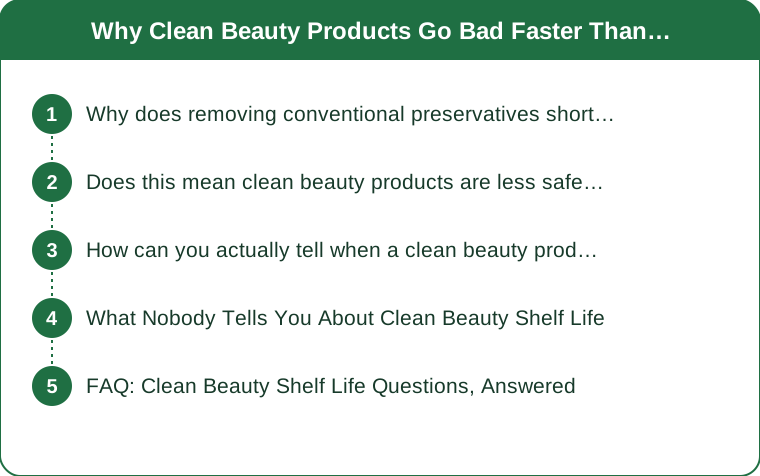
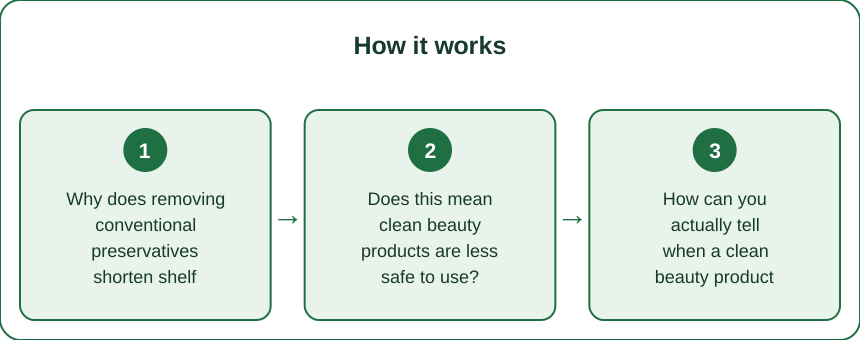
Why does removing conventional preservatives shorten shelf life?
Preservatives exist specifically to slow bacterial, mold, and yeast growth in a product — clean beauty formulas that minimize or avoid synthetic preservatives in favor of gentler natural alternatives typically get less microbial protection in exchange, which is a real functional tradeoff, not just a marketing distinction.
Does this mean clean beauty products are less safe to use?
Not inherently — a properly formulated clean beauty product is safe within its shorter usable window, the same way any product is safe within its stated shelf life. The risk comes from using a product well past when it should’ve been replaced, which happens more easily with clean beauty because the shorter window is less commonly understood.
How can you actually tell when a clean beauty product has gone bad?
Watch for a change in smell (often a sour or musty note), a change in texture (separating, becoming watery, or clumping), or a visible color shift — any of these signals it’s time to replace the product regardless of the printed expiration date, which is based on unopened storage, not real-world daily use.
What Nobody Tells You About Clean Beauty Shelf Life
Marketing around clean beauty focuses heavily on what’s excluded from the formula, but almost never mentions what that exclusion costs in terms of usable lifespan. A $40 clean beauty serum that goes bad in four months isn’t necessarily worse value than a $25 conventional one that lasts a year — but you need to actually finish the product to get your money’s worth, which changes the math on bigger sizes.
FAQ: Clean Beauty Shelf Life Questions, Answered
Should I buy smaller sizes of clean beauty products specifically?
Yes, generally — smaller sizes reduce the chance of a shorter-shelf-life product going bad before you finish it, even if the per-ounce cost is slightly higher.
Does refrigerating clean beauty products actually extend their life?
For many formulas, yes — cooler storage slows the same microbial growth that shorter preservation was already struggling to control, and it’s a low-effort way to get more usable life from the product.
Are all ‘clean beauty’ products equally short-lived?
No — it varies significantly by formula and preservative system used; some clean beauty lines use effective natural preservative blends that perform close to conventional shelf life, so checking the specific product’s guidance is more useful than assuming a fixed rule.
TL;DR:
- Clean beauty formulas often use fewer or gentler preservatives, which shortens usable shelf life
- A shorter shelf life doesn’t mean less safe — it means a shorter safe window
- Smell, texture, and color changes are more reliable signals than the printed date
- Buying smaller sizes and storing products cool helps you actually finish them before they turn
Next time you shop clean beauty, size down before sizing up — it protects both your skin and your money.
Keep Reading
This article is for general informational and styling purposes only. Fit, sizing, and product availability may vary.