The Preservative Tradeoff Clean Beauty Doesn't Always Explain
Quick Answer: Preservative-free products carry a higher risk of bacterial and mold contamination, especially once opened and exposed to air or fingers repeatedly — a well-formulated preservative system is often the safer choice, not the compromise clean beauty marketing sometimes implies.
“Preservative-free” gets marketed as automatically cleaner, but that framing skips the actual tradeoff: preservatives exist specifically to stop bacteria and mold from growing in a product you’re putting on your skin.
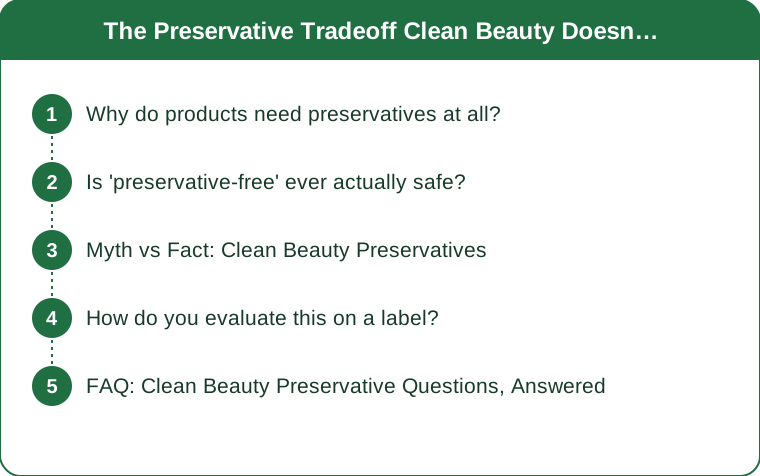
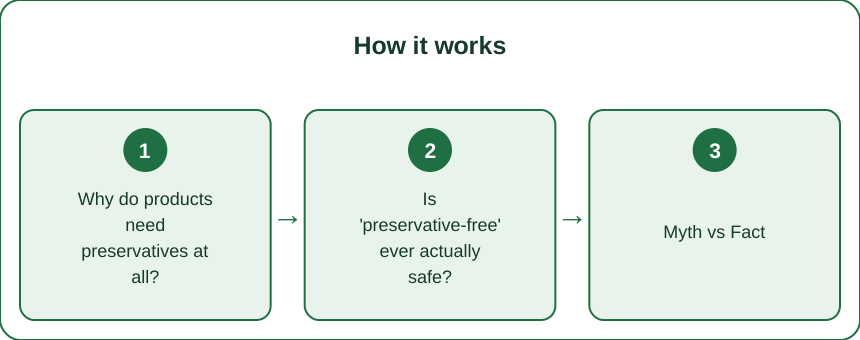
Why do products need preservatives at all?
Any product containing water — which is most skincare — is a viable environment for bacterial and mold growth once opened and exposed to air, fingers, and bathroom humidity repeatedly over weeks or months. Preservatives exist to stop that growth, not to add unnecessary chemicals — removing them doesn’t remove a risk, it removes a safeguard.
Is ‘preservative-free’ ever actually safe?
It can be, under specific conditions — products packaged in airless pumps, sold in very small single-use sizes, or genuinely water-free formulations (some oils, some balms) have lower contamination risk without added preservatives. A preservative-free product in a wide-mouth jar, opened repeatedly with fingers over months, is a different and riskier situation entirely.

Myth vs Fact: Clean Beauty Preservatives
Myth: All preservatives are equally harsh or synthetic. Fact: Preservative systems range widely — some are naturally derived, some are gentler synthetic options specifically chosen for sensitive skin formulations.
Myth: A shorter ingredient list is automatically safer. Fact: A shorter list without a preservative can mean a shorter safe shelf life and higher contamination risk, not necessarily a cleaner product.
Myth: You’ll be able to tell if a product has gone bad. Fact: Bacterial contamination isn’t always visible or detectable by smell — a product can look and smell normal while still carrying a risk, which is part of why preservative systems matter.
How do you evaluate this on a label?
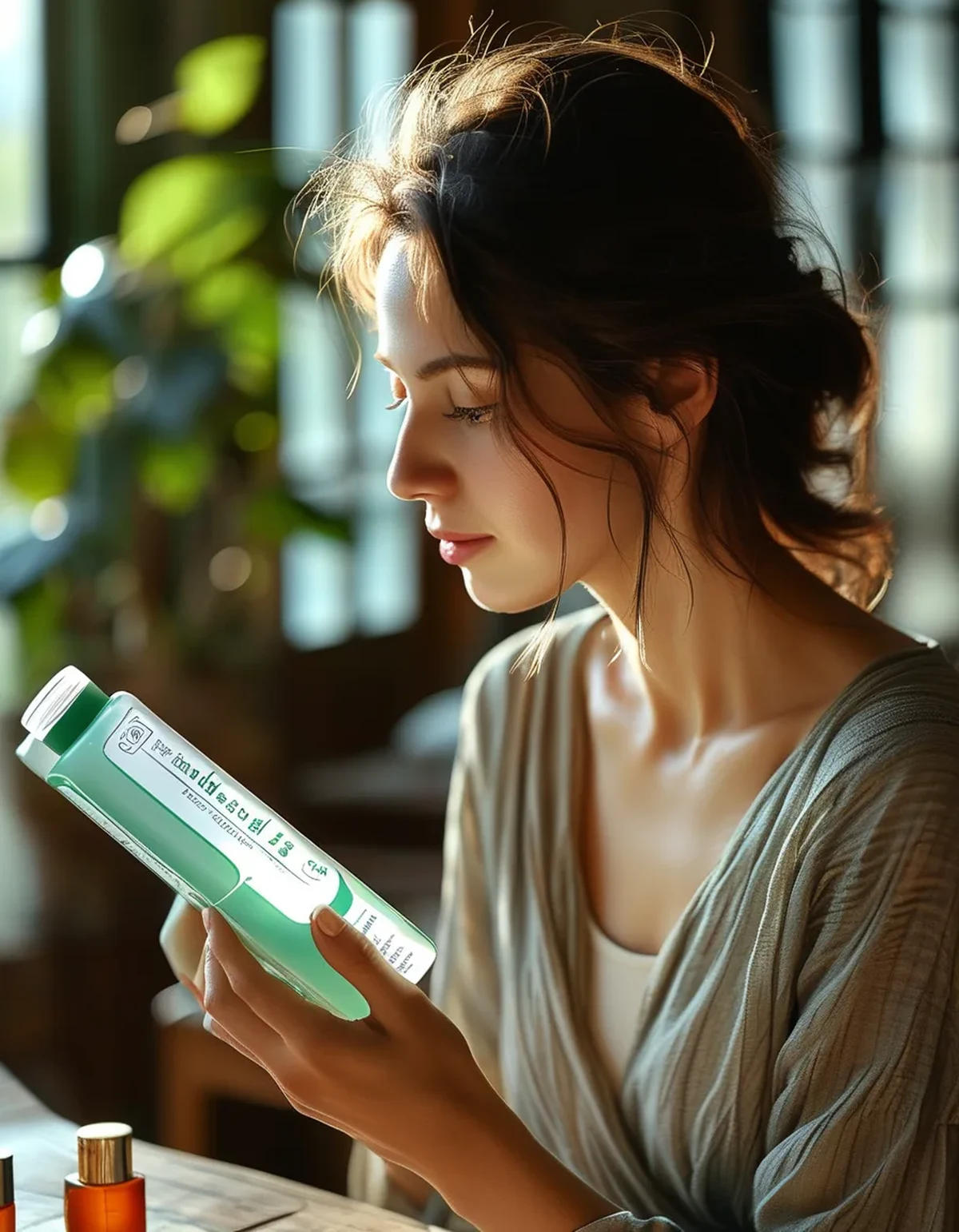
Check the packaging type first — airless pumps and droppers reduce contamination risk regardless of preservative status, while jars increase it. If a product is preservative-free and in a jar, a shorter use-by window after opening (often 3-6 months) is the safer assumption, even if the label doesn’t explicitly say so.
FAQ: Clean Beauty Preservative Questions, Answered
Are natural preservatives as effective as synthetic ones?
Effectiveness varies by specific ingredient and formulation, not by natural-versus-synthetic as a category — some natural preservative systems are well-tested and effective, others are weaker than marketing suggests.
Should I avoid all products with parabens?
Paraben concerns are debated and evolving; if avoiding them specifically matters to you, look for alternative preservative systems rather than no preservative system at all.
How can I tell if an opened product has gone bad?
Changes in smell, color, texture, or separation are signs, but the absence of these signs doesn’t guarantee safety — following the stated period-after-opening symbol is more reliable than relying on your senses alone.
TL;DR:
- Preservatives exist to prevent bacterial and mold growth in water-based products
- Preservative-free is genuinely low-risk mainly in airless packaging or truly water-free formulas
- Not all preservative systems are harsh — effectiveness and gentleness vary by ingredient
- Jarred, preservative-free products carry the highest contamination risk over time
A well-chosen preservative system is often the safer choice, not the compromise it’s sometimes framed as.
Keep Reading
This article is for general informational and styling purposes only. Fit, sizing, and product availability may vary.