Clean Beauty Fragrance Terms Decoded: What 'Fragrance-Free' Actually Means vs. 'Unscented'
Quick Answer: ‘Fragrance-free’ means no fragrance ingredients (including masking fragrances) were added at all, while ‘unscented’ often means a masking fragrance was added specifically to cancel out the smell of other ingredients — the two terms are not interchangeable, and ‘unscented’ products can still trigger fragrance sensitivities.
Both labels promise a product without a noticeable smell, but only one of them actually means no fragrance ingredients were used — and the difference matters if you’re managing sensitive skin.
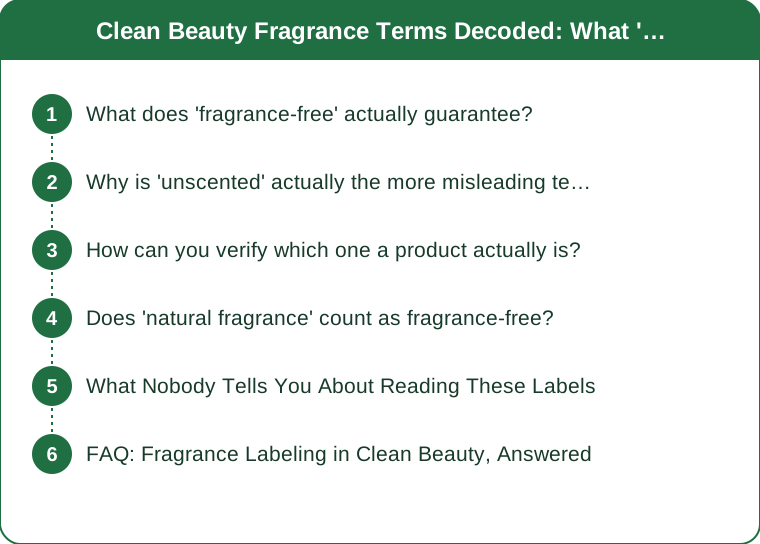
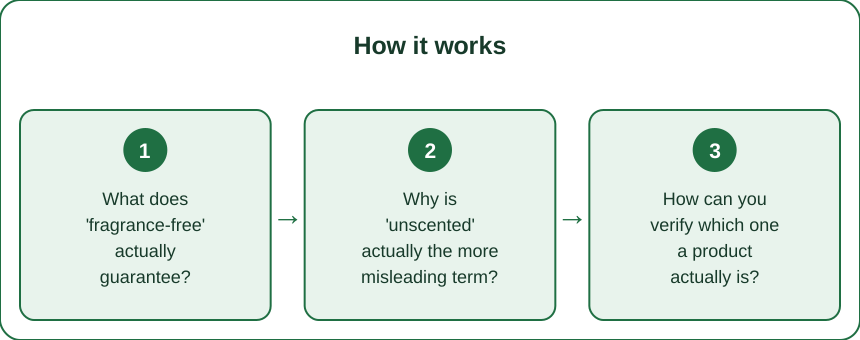
What does ‘fragrance-free’ actually guarantee?
A genuinely fragrance-free product contains no added fragrance ingredients of any kind, including the masking fragrances sometimes used to neutralize the natural smell of active ingredients. This is the more reliable term for anyone managing fragrance sensitivity or allergy, since it reflects an absence of the ingredient category entirely rather than just an absence of detectable smell.
Why is ‘unscented’ actually the more misleading term?
‘Unscented’ products frequently do contain fragrance ingredients, added specifically to mask or cancel out the base smell of other ingredients so the final product doesn’t have a noticeable odor. This means someone reacting to fragrance compounds specifically can still have a reaction to an ‘unscented’ product, even though it doesn’t smell like anything.
How can you verify which one a product actually is?
Check the full ingredient list for the word ‘fragrance’ or ‘parfum’ — if either appears, the product isn’t truly fragrance-free regardless of how it’s marketed on the front label. Front-of-package claims aren’t regulated as strictly as ingredient labeling, so the ingredient list is the more reliable source.
Does ‘natural fragrance’ count as fragrance-free?
No — essential oils and other natural fragrance sources are still fragrance ingredients from an allergy and sensitivity standpoint, even though they’re derived from plants rather than synthesized. A product can be entirely ‘natural’ and still trigger the same reactions as a synthetic-fragrance product for someone with fragrance sensitivity.
What Nobody Tells You About Reading These Labels
The front-of-package term is essentially marketing language, while the ingredient list is the actual regulated disclosure — for anyone managing sensitive or reactive skin, developing the habit of skipping straight to the ingredient list rather than trusting the front claim avoids most labeling confusion entirely.
FAQ: Fragrance Labeling in Clean Beauty, Answered
Are ‘fragrance-free’ products always better for sensitive skin?
Generally yes, though sensitivity to other specific ingredients can still occur — fragrance-free addresses one common trigger, not every possible one.
Do essential oils have to be listed as ‘fragrance’ on labels?
Requirements vary by region and product category, so checking for the essential oil name directly in the ingredient list is a more reliable check than looking for the word ‘fragrance’ alone.
Is there a term that’s more reliable than either of these two?
Looking directly at the ingredient list for the absence of ‘fragrance,’ ‘parfum,’ or named essential oils is more reliable than trusting any single front-label term.
TL;DR:
- ‘Fragrance-free’ means no fragrance ingredients were added at all, including masking fragrances
- ‘Unscented’ often still contains fragrance ingredients used to cancel out other smells
- Natural fragrance sources like essential oils still count as fragrance for sensitivity purposes
- Always check the actual ingredient list rather than trusting the front-label term
Next time you’re shopping for fragrance-sensitive skin, skip the front label and go straight to the ingredient list — it’s the only reliably accurate source.
Keep Reading
This article is for general informational and styling purposes only. Fit, sizing, and product availability may vary.