Clean Beauty Dupes vs Originals: What the Ingredient List Actually Tells You
Quick Answer: Ingredient lists are ordered by concentration down to 1 percent, after which order is arbitrary. That means two products can share the same first five ingredients and differ enormously below that line, where most actives sit. To compare a dupe fairly, find the 1 percent marker - usually the first preservative or fragrance - and read what sits above it, not what appears anywhere on the list.
The dupe economy runs on a real gap in how ingredient lists are regulated. Nothing is being hidden. It is just that the disclosure rules stop being useful right where you need them most.
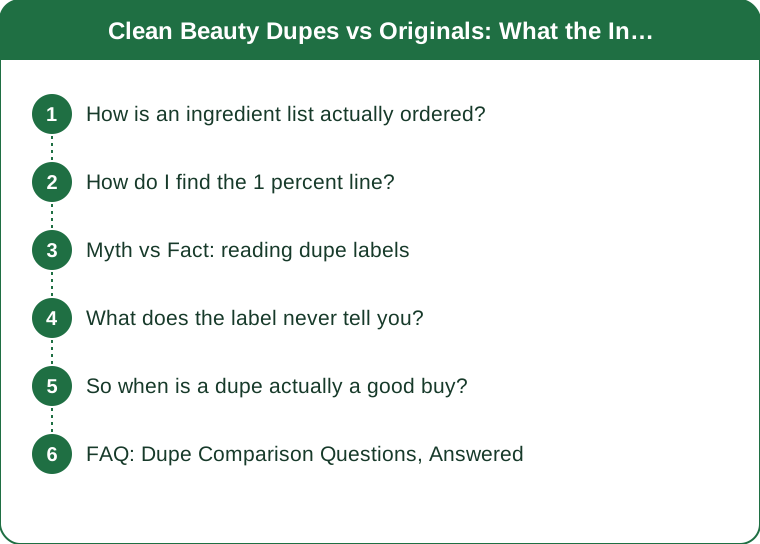
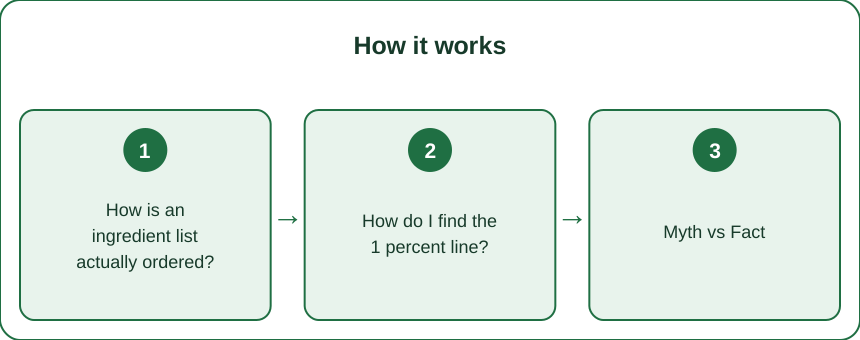
How is an ingredient list actually ordered?
By descending concentration, but only until you hit 1 percent. Below that threshold, manufacturers may list remaining ingredients in any order they like.
This is standard practice under cosmetic labeling rules in both the US and EU, and it is not a loophole - it is written into the regulations.
The practical consequence is large. Most high-performance actives work at concentrations between 0.1 and 2 percent, which puts them squarely in the region where order tells you nothing. Retinol at 0.3 percent and retinol at 0.03 percent appear identically on a label.
So when a dupe lists the same active as a product costing four times as much, the label genuinely cannot tell you whether the concentrations match. What it can tell you is where the active sits relative to the 1 percent line.
How do I find the 1 percent line?
Look for the first ingredient that is legally capped at or near 1 percent. These act as reliable markers.
Common ones: phenoxyethanol (capped at 1 percent), sodium benzoate, potassium sorbate, carbomer, xanthan gum, tocopherol, disodium EDTA, and fragrance or parfum in most formulations.
Everything listed above the first of these is present at more than about 1 percent. Everything below is at or under it.
Now the comparison becomes useful. If the original lists niacinamide third, above phenoxyethanol, and the dupe lists it fourteenth, below phenoxyethanol and after three fragrance components, those are not the same product regardless of what the marketing says.
This single trick is the most useful thing in label reading and it takes about 15 seconds per product.
Myth vs Fact: reading dupe labels
Myth: Same ingredients means same product. Fact: Concentration, delivery system, and pH all change performance, and none of the three appear on a label.
Myth: A shorter ingredient list is better. Fact: Short lists sometimes mean fewer stabilizers, which can mean a less stable product. Length is not a quality signal in either direction.
Myth: If the active is first, the product is strong. Fact: Water is first in almost every water-based formula. The first non-water ingredient is a more useful reference point.
Myth: Clean formulations always have fewer ingredients. Fact: Replacing one synthetic preservative often requires two or three alternatives plus pH adjusters, which can make a clean formula’s list longer, not shorter.
What does the label never tell you?
Four things that matter as much as the list, and none of them are printed.
Concentration below 1 percent. Already covered, and it is the biggest gap.
pH. Vitamin C as L-ascorbic acid needs a pH below about 3.5 to be effective. Exfoliating acids need a specific range. A formula with the right ingredient at the wrong pH does very little. Some brands publish this; most do not.
Delivery system. Encapsulated retinol behaves differently from free retinol at the same concentration - slower release, less irritation, different effective dose. Both are listed as retinol.
Stability and packaging. Vitamin C, retinol, and many plant extracts degrade with light and air. The same formula in an airless pump and in a clear jar are functionally different products by month three.
That last one is the easiest to check yourself and the one dupes most often cut costs on. A clear jar for a light-sensitive active is a genuine red flag, regardless of what the list says.
So when is a dupe actually a good buy?
More often than the skeptical version of this article would suggest.
Dupes tend to work well for simple, high-concentration, well-understood formulas - a plain glycerin and hyaluronic acid hydrator, a basic ceramide moisturizer, a mineral sunscreen, an azelaic acid at a disclosed percentage. In those categories the formulation is not the hard part and the ingredient list is genuinely informative.
They tend to disappoint on low-concentration actives, encapsulated delivery, and anything where texture is the selling point. A dupe of a light serum that feels heavy is not a formulation you will use, and an unused product has zero efficacy at any price.
The honest buying rule: if the brand publishes the percentage of the active, the dupe comparison is meaningful. If neither brand publishes it, you are comparing marketing.
Buy the smallest size first, patch test on the inner forearm for 3 to 5 days, and give any new active 8 to 12 weeks before judging. Most disappointment comes from a 3-week verdict on a 12-week product.
FAQ: Dupe Comparison Questions, Answered
Does the country of manufacture matter?
Less than people assume for safety - the EU restricts more ingredients than the US does, but both have functioning cosmetic regulation. It matters more for which preservatives are permitted, which affects shelf life.
Why does the dupe feel different if the list is identical?
Usually the ratios of the emulsifiers, thickeners, and silicone-alternatives that sit in the middle of the list. Texture comes from those, and they are exactly where the below-1-percent ambiguity bites.
Is a more expensive product ever objectively better?
Sometimes - for stability, packaging, and disclosed concentrations. Often not, for basic hydrators and cleansers where the formulation is well understood. The price tells you nothing on its own.
TL;DR:
- Ingredient lists are ordered by concentration only down to 1 percent, after which order is arbitrary.
- Find the 1 percent marker - phenoxyethanol, carbomer, xanthan gum, fragrance - and read what sits above it.
- Labels never disclose concentration below 1 percent, pH, delivery system, or stability.
- A clear jar holding a light-sensitive active is a genuine red flag no matter how good the list looks.
- Dupes work well for simple high-concentration formulas and poorly for low-dose or encapsulated actives.
- If neither brand publishes the percentage, you are comparing marketing, not chemistry.
As the weather cools and routines get heavier, this is a good month to audit what is actually in the products you are about to repurchase.
Keep Reading
This article is for general informational and styling purposes only. Fit, sizing, and product availability may vary.