Why 'Clean Beauty' Certifications Don't Actually Mean What You Think
Quick Answer: ‘Clean beauty’ is not a legally regulated or standardized term in the US — there’s no single government body defining what qualifies — which means different brands, retailers, and certification seals each use their own private criteria, and a product can carry a ‘clean’ label under one standard while failing another’s criteria entirely.
You’ve started choosing products specifically because they’re labeled ‘clean beauty,’ assuming that means something consistent and verified. The reality is closer to a patchwork of different private standards, not a single regulated benchmark.
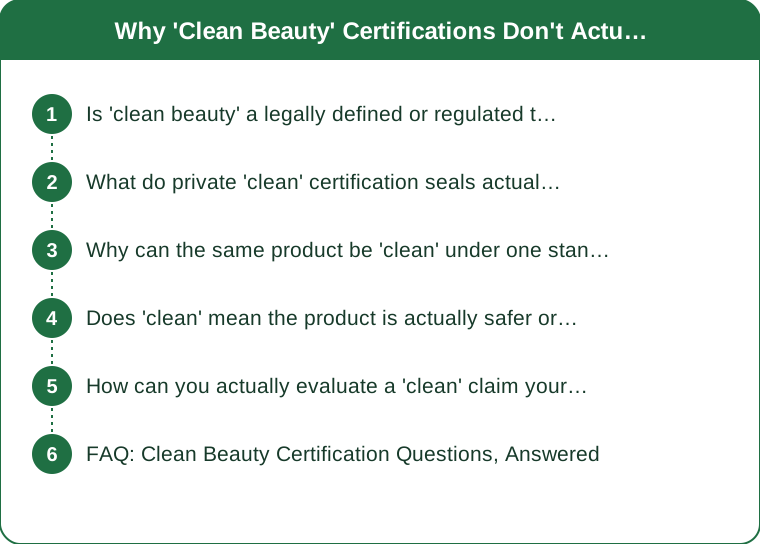
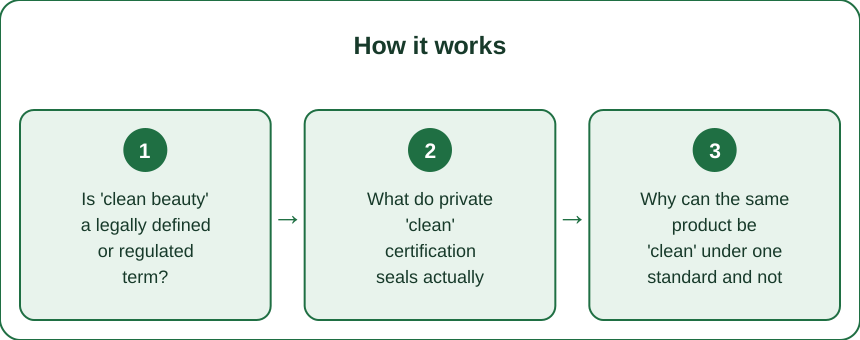
Is ‘clean beauty’ a legally defined or regulated term?
No — unlike terms such as ‘organic’ (which has USDA-regulated criteria), ‘clean beauty’ has no legal or government definition in the US. Any brand can use the term on packaging without meeting any external, verified standard, which is the core reason the label varies so widely from product to product.
What do private ‘clean’ certification seals actually verify?
Different retailers and certification bodies (some major retailers’ own ‘clean’ seals, for example) each maintain their own private list of restricted or banned ingredients, and products are checked against that specific list. This means a seal genuinely does verify something — just something specific to that one organization’s criteria, not a universal standard.
Why can the same product be ‘clean’ under one standard and not another?
Because each certifying body’s restricted ingredient list differs — an ingredient banned under one retailer’s clean standard might be permitted under another’s, or excluded from a third’s list entirely simply because it wasn’t included in their specific criteria.
Does ‘clean’ mean the product is actually safer or more effective?
Not automatically — clean beauty certifications generally address ingredient sourcing and exclusion lists, not safety or efficacy testing in the way a drug or medical product would be tested. A ‘clean’ label says a product avoided certain ingredients, not that it’s clinically proven safer or more effective than a non-clean alternative.
How can you actually evaluate a ‘clean’ claim yourself?
Checking which specific certification (if any) backs the claim, and looking up that certifier’s actual criteria, gives a much clearer picture than trusting the word ‘clean’ alone. A product with no named certification behind the claim is using the term with essentially no external verification at all.
FAQ: Clean Beauty Certification Questions, Answered
Is ‘natural’ the same as ‘clean’ beauty?
No — ‘natural’ is an even less regulated term than ‘clean,’ and the two are often used interchangeably in marketing despite having no consistent, shared definition either.
Are clean beauty products worth paying more for?
That depends entirely on your personal priorities around specific ingredients — the premium reflects sourcing and formulation choices, not a guarantee of superior safety or performance.
What’s a more reliable way to evaluate a product than the ‘clean’ label alone?
Reading the actual ingredient list and checking specific ingredients you want to avoid is more reliable than trusting a single marketing term, regardless of which certification (if any) is behind it.
TL;DR:
- ‘Clean beauty’ has no legal or government-regulated definition in the US
- Different certifiers use different private restricted-ingredient lists, so labels aren’t standardized
- A ‘clean’ label addresses ingredient exclusion, not proven safety or efficacy
- Checking which specific certification backs a claim gives a clearer picture than the word ‘clean’ alone
The label isn’t meaningless, but it means something narrower and more specific than most people assume.
Keep Reading
This article is for general informational and styling purposes only. Fit, sizing, and product availability may vary.